Tag Archives: featured

These 10 Companies Control Almost Everything we Consume
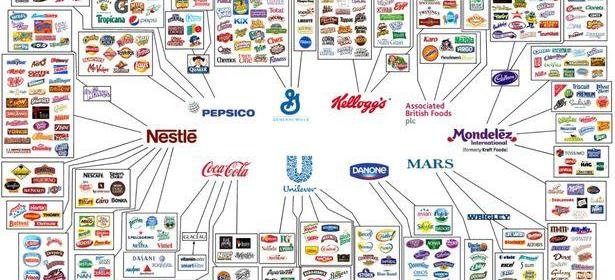
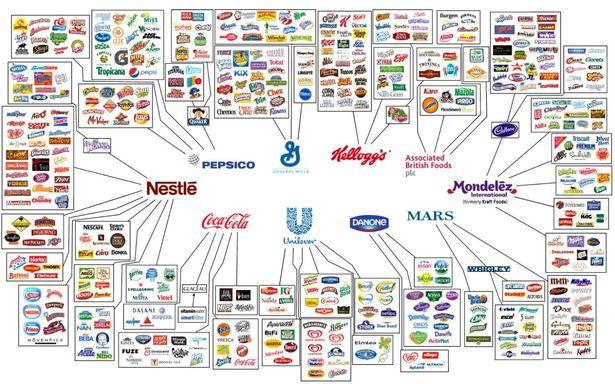
It’s a scary thought isn’t it. All of our favourite brands owned and controlled by no more than 10 individual companies. How is it possible for such a small number of companies to be associated with every single major food and drink brand that we have ever come across and who are they? Some of them you will most likely recognise and some maybe not. 6 of these companies are American, 1 is Swiss, 1 is British, 1 is French and there is also a British-Dutch company.

Oxfam released the information as a way of spreading awareness about the huge concentration of market power in the industry so that people would be aware of who owns what they are buying, ultimately in an effort to push these companies to make positive changes. Let’s take a look at them:
https://i2-prod.walesonline.co.uk/lifestyle/fun-stuff/article11942892.ece/ALTERNATES/s615b/1.jpg
  1. Mondelez
https://i2-prod.walesonline.co.uk/lifestyle/fun-stuff/article11943010.ece/ALTERNATES/s615b/1.png

Mondelez made about $25.9 billion in snacks in 2017. They own all of Cadbury (which incorporates a huge number of chocolate bars such as Crunchies, Freddos and Twirls) as well as other consumer favourites Oreo, Milka and Toblerone. They also own Sour Patch Kids and Kenco.

2.Unilever
https://i2-prod.walesonline.co.uk/lifestyle/fun-stuff/article11943017.ece/ALTERNATES/s615b/1.jpg

Another one of the well known companies that make up the 10 we will discuss. Unilever owns a vast wide-ranging catalog of brands including Lyons, Knorr and Hellmans. They are also the single biggest ice cream producer in the world with Magnum, Cornetto and Ben ‘n Jerrys under their belt. Unilever accumulated $51 billion in revenue in 2018.

3. Coca Cola
https://i2-prod.walesonline.co.uk/lifestyle/fun-stuff/article11943019.ece/ALTERNATES/s615b/1.jpg

Next on the list is soft drink giant Coca Cola. Coming in at a revenue in 2017 of 35.41 billion, the company is in charge of Coke, Sprite and Fanta. It is not just soft drinks that they own however as they also control Smart Water, Innocent Smoothies and Honest Tea.

4. Nestlé
The Swiss company made a staggering $90.8 billion revenue in 2017. These guys produce a lot of the chocolate we consume that Mondelez doesn’t under Cadbury. This includes KitKat, Smarties, Rolos and Aeros. They also own Nescafe of course but one that you mightn’t have been aware of is Polo mints being owned by Nestlé.

5. PepsiCo

https://i2-prod.walesonline.co.uk/lifestyle/fun-stuff/article11943299.ece/ALTERNATES/s615b/1.jpg

As far as drinks go PepsiCo owns Pepsi, Gatorade and Tropicana fruit juices. Interestingly they also own and market the Starbucks drinks available outside of Starbucks stores. Surprisingly Walkers is owned by PepsiCo, meaning that they control the production of Walkers crisps, Doritos and Cheetos. They recorded revenue of $63.53 billion in 2017

6. General Mills
https://i2-prod.walesonline.co.uk/lifestyle/fun-stuff/article11943307.ece/ALTERNATES/s615b/1.png

$15.62 billion is how much this company managed to make in 2017. They did this through their companies that include Green Giant, Old El Paso and Nature Valley. Not to mention the fact that they own 25 different cereal brands, one of which is Cheerios. Haagen-Dazs is another company owned by General Mills and they also own Parker Bros., the makers of Monopoly.

7. Kellogs
https://i2-prod.walesonline.co.uk/lifestyle/fun-stuff/article11943313.ece/ALTERNATES/s615b/1.jpg

Kellogs made $12.92 billion revenue in 2017, smaller compared to the rest of the companies in this domain but certainly not something to be scoffed at. This company produces Kellogs alongside over 30 other different cereals. Pringles, Nutri-Grain and Pop-Tarts are produced by Kellogs as well.

8. Associated British Foods
https://i2-prod.walesonline.co.uk/lifestyle/fun-stuff/article11943330.ece/ALTERNATES/s615b/1.jpg

The only solely British company in this group received revenue of roughly $19 billion in 2018. Probably owning some of the lesser known brands in the group, the company is in charge of brands like Twinings, Kingsmill and Ryvita Biscuits. They are however responsible for the export of massive American brands such as Tabasco hot sauce and Skippy peanut butter.

9. Mars

https://i2-prod.walesonline.co.uk/lifestyle/fun-stuff/article11943348.ece/ALTERNATES/s615b/1.jpg

Apart from the obvious, Mars owns pretty much any chocolate that isn’t Cadburys or Nestlé. Chocolate such as M&M’s, Galaxy and Snickers. What’s less obvious is their ownership of Wrigleys, which produces a plethora of chewing gum brands like Extra, Hubba Bubba and Orbit. Wrigleys also makes Skittles and Starbursts. The brands that few people would know are owned by Mars include Uncle Ben’s and Dolmio. $35 billion is how much revenue Mars made in 2017.

10. Danone
https://i2-prod.walesonline.co.uk/lifestyle/fun-stuff/article11943361.ece/ALTERNATES/s615b/1.jpg

In 2017, Danone received roughly $27.5 billion in revenue. Bottled water brands Evian and Volvic as well as yoghurts Activia and Actimel are owned by Danone. They also sell medical nutrition products such as Cow and Gate.

So there you have it. These are the 10 companies and the brands that they own. I’m sure you’ve heard of most if not all of these companies. However, it is still a little overwhelming to see just how many brands they own between them. Hopefully you got some interesting insight into who actually owns what brands and if you’re anyway similar to me, you will find it difficult to eat your Uncle Ben’s microwave rice knowing that it is made by the same company as your beloved M&M’s.

Differences between Hard and Soft skills? Why are they so important for employers?

  • What are the skills employers are looking from the graduates?
  • How can YOU learn those skills and become a better candidate for an internship or a job?
  • What are the differences between soft and hard skills?
  • Why are they so important?

What are the Hard skills?

  • Hard skills are the tough skills.
  • They show your knowledge about the job and your ability to do the work right.
  • They are specific to each job and are basis of job requirements.
  • They are quantifiable and are often learned in school, through earned certifications or in previous work experiences.
  • These skills can also be considered “resume keywords,” which are words recruiters use to search for applicants. Each resume should use the exact hard skills found in the job description.

What are the Soft Skills?

  • Soft skills are interpersonal skills.
  • These are much harder to define and evaluate.
  • They show how well employee can interact with customers.
  • They are non-measurable and so not specific to any job or career.
  • Soft skills are “people” skills.
  • These skills are personality traits that help define character but offer less proof of experience than hard skills.
  • Soft skills include communication skills, listening skills, and empathy etc.

Hard Skills List  

Examples of Hard Skills:                                        

  • Data Analysis                                                
  • Planning Skills                                               
  • Accounting
  • Financial
  • Software
  • Word Processing
  • Writing

Tips I recommend to improve your Hard skills

  • It is not a surprise that almost every type of job is in a strong connection with computers. Examples of basic computer skills are the ability to work with Windows, Microsoft Word, Microsoft Excel, PowerPoint, Outlook Express and Windows Share Folders. If you need education or additional learning for these essential computer skills, here are some helpful courses:

1) Microsoft Excel Course – Excel from Beginner to Advanced:

2) Microsoft Excel and PowerPoint Training With Certificate Data Analysis

  • Analyzing some kind of data is a common part of many job positions and responsibilities. There are many reasons to learn data analysis: want to start a new career, want to develop your hard skills in your current career, or you want to know how to use, collect and present data for any purpose. If you have one of the above reasons, here are 2 important courses that can help:

1) Complete Introduction to Business Data Analysis

2) Data Science A-Z: Real-Life Data Science Exercises Included

  • Knowing Foreign Languages: Although English is the official business correspondence language for many countries, it is a big advantage to know other languages. Examples of the most required languages are German, Spanish, French, Chinese. So, is it the time to go and start learning a new language? And the answer is – Yes. It will make you a better candidate for any internship or a job. Check out some courses here: https://www.duolingo.com/courses

Soft Skills List

Examples of Soft Skills include:

  • Leadership skills
  • Communication Skills
  • Adaptability and flexibility
  • Problem-solving
  • Creativity
  • Time management skills
  • Willingness to learn

Five tips I recommend to improve your Soft skills

  1. Build self-awareness – Understand why you react to certain situations and certain people in a certain way. In order to develop any self-management skill, you first have to understand yourself.
  2. Change yourself not others – Some people might think or say that improving soft skills can help you manipulate other people actions. However, it is not true. Improving soft skills is all about changing yourself, your perception, your approach to situations.
  3. Understand other people’s motivations – Any action that cause a conflict and trigger yours or other person’s insecurity, will create a difficult or unexpected situation. By proactively trying to put yourself in their shoes before any interaction, you could communicate better and can better manage your reaction to unexpected situations.
  4. Start Easy and Relax –You cannot improve all your soft skills over one night, so identify one soft skill you want to start with. Start researching (books, blogs, etc…) and practice on that one skill. Once you make progress on one soft skill, it will give you the confidence to improve more on others a step at a time.
  5. Practice, Practice, Practice – Sadly soft skills are not something you can just study in a book to get better, improvement takes practice over time. Improving soft skills is fundamentally about changing your behaviour toward yourself and others. Every next interaction you have with people at work is an opportunity to practice a soft skill!

HARD Skills vs. SOFT Skills

A combination of hard skills and soft skills forms a well-rounded job applicant. While hard skills are quite different than soft skills, together, they create a good balance between hard knowledge and interpersonal attributes. Hard skills show mastery and proficiency while soft skills show communication and relational abilities.

The balance of hard and soft skills is important. Hard skills help the applicant get past ATS while showing experience level and qualification for the position. Soft skills make the applicant human, showing leadership, empathy, and character. Both of them added together can make a perfect employee or a graduate.

So, which skills are more important – hard or soft?

Of course, both of them are equal. Balance is the key and the best answer here. So, make sure that your resume and/or CV contains enough skills of both types! Good luck!

Boojum: Hungry for Growth

Boojum. It’s everyone’s favourite burrito joint, right? Although we are all aware of the divide in opinion about the best place to grab a burrito, one must admit that Boojum stores just seem to keep on popping up out of nowhere. That just can’t be a coincidence. In the next few paragraphs or so we will delve into how exactly the company came to be where it is today (Undoubtedly the best burrito place around), what’s been happening for them recently and where it is they aspire to take their Mexican wholesomeness in the years to come.

Burritos in Belfast:

            Boojum was established in 2007 by John and Karen Blisard when they opened a burrito bar called Boojum in Belfast. The idea of having a burrito bar was unusual at the time in Ireland but the couple refused to listen to outside criticism and skepticism and continued to run their burrito place despite the boldness of the move. It took €200,000 to get the first Boojum restaurant up and running and this was the only Boojum around for 3 years until the Blisard’s opened their second restaurant in Dublin in March 2010 followed by another in Belfast City Centre later on that year.

The Belfast couple experienced continued growth and in 2013 opened another restaurant in Galway and their fifth one on Kevin Street a year later. Their expansion plan was simple, to find good locations with affordable rent. It is also interesting to note the couples reluctancy to franchise their business, something that they admit was due to their research into their highly successful US counterpart “Chipotle” and the fact that they did not franchise their business.

Buying Boojum:

The initial success of Boojum lead to it being bought in 2015. The burrito chain was taken over by a partnership between Renatus Capital Partners and former Ulster rugby player Andrew Maxwell. Renatus is a private equity company that is backed by wealthy individuals and this was the first deal for them since their establishment, taking a 50% stake of the company. The other half goes to Andrew Maxwell along with his brother David, who previously ran a number of restaurants in the US. The company was bought for over €3 million.

In the last 4 years Boojum has gone from 5 to 18 stores and now spans from 5 restaurants in Belfast and 9 in Dublin to locations in Galway, Cork, Limerick and even just last month opening its newest restaurant in Derry. The now Managing Director David Maxwell states that targeting the brand at a core market of young professionals and students aged 18-40, with the disposable income and desire to eat out regularly in the evening but also requiring speedy delivery at lunchtime has been key to growing the Mexican food chain. The company has also increased its workforce from 125 to just under 600 employees.

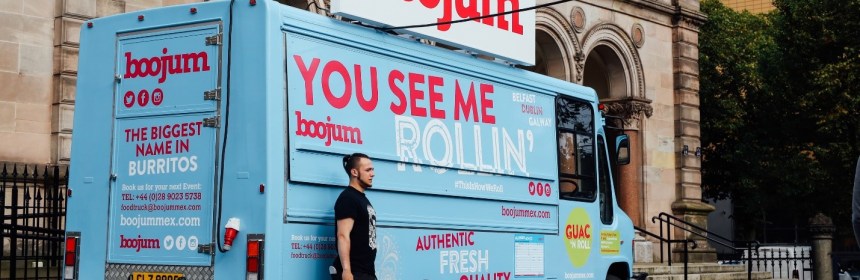
The company has not only been opening up new stores but has been exploring other possible ways to maximise its growth. In 2016 Boojum teamed up with Deliveroo so that people could order their well needed burrito fix straight to their door. Not only this but they launched their “Boojmobile” to serve college campuses and festivals when burritos are typically that bit harder to access. These developments by Boojum really showcase their understanding of their target market and their ability to exploit the opportunities available to them.

In their financial year 2017-2018 (year ended 23rd April last) Boojum recorded revenue of €18.5 million, a growth of more than 50% from their previous year. They did however record pre-tax losses of just over €650,000. This was due to exceptional costs such as store closures during the “Beast from the East” and delayed store openings. The directors state that “overall, it proved to be a very positive transitional year for Boojum. By the end of the period, the group had a strong foothold in Ireland, new stores were established and management was well positioned to explore new opportunities to drive the business forward”. Boojum has evidently put itself into a very favorable position, one as aforementioned will grant them access to expand on their recent prosperity.

British Burritos:

             Brexit has admittedly been a concern for the company considering its cross-border presence says Maxwell. They are tasked with trading and purchasing in multiple currencies and so they must manage the risks associated with this. Maxwell also states that looking forward they are trying to understand what the impact of a hard/soft Brexit might be on their supply chain and logistics. Despite all this there have been rumours of Boojum targeting Britain in the years to come. Although it is too early to really know whether this will happen or not it would not come as a surprise. I mean where else can you go when you’ve already established yourself so strongly in the Irish market and you’re still hungry for growth.

Tangential Opportunities: Trinity’s Idea Workspace

John Fink

If you’ve walked through the Berkley Library, and looked to your right as you entered the front door, you may have seen a small room with a lot of blue posters put up around it. This small room may seem innocuous, but actually, it’s a really cool place. Until May 27th of this year, when they move to the new business school, that room is the home of Tangent: Trinity’s Ideas Workspace, A multi-disciplinary, college wide entrepreneurship and innovation initiative. The Tangent program offers several resources that extend far beyond the small borders of the room; If you’re the budding entrepreneurial type, or maybe you never though of yourself as an innovator but have an idea that you think is good, then you’ll absolutely want to stop into the Tangent room or give a look to their website.

Read more

Trinity Business Review – What We’re About

James O’ConnorKevin Boland & Conor Kelly

The Trinity Business Review (TBR) is the first publication of its kind in Europe. Last year, our team recognised a need for a platform to connect undergraduates, graduates and working professionals alike to the latest business developments in country. To bridge this link, we founded TBR, an online based, student led business publication.

Read more

« Older Entries Recent Entries »