Category Archives: Uncategorized

Budget 2021: What We Know So Far

By Paul Ralph

  • Minister announces no changes to PAYE, USC or PRSI.
  • Central Bank Governor Gabriel Makhlouf calls for path to “sustainable debt” and a focus on building resilience to future shocks.
  • IBEC lobbies for gradual tapering of business supports into 2021 as opposed to a “cliff-edge” end.

Last Wednesday, the Minister for Finance Paschal Donohoe confirmed that there would be no changes to income tax, USC or PRSI. At a press briefing he explained that cabinet had agreed that increases in taxation would be counterproductive. The Minister wants to “give confidence to those earning income or who a have level of deposits in our economy” in a time of “heightened economic uncertainty”. The main focus of the government is the management of the Covid-19 crisis and the looming prospect of a no-deal Brexit at the end of the year. This was made clear when the Minister explained that only “future budgets” would be guided by the commitments made in the Programme for Government agreed between the three governing parties. 

Minister Donohoe declined to rule out any possible changes to welfare payments.

Donohoe’s Fianna Fáil counterpart, Minister for Public Expenditure and Reform Michael McGrath said that government spending this year would be 23% higher than forecasted due to the unprecedented scale of government intervention in the economy due to the Covid-19 pandemic.   

The unpredictability of the current crisis is adding to the difficulty of planning a budget. Speaking to RTÉ news on Wednesday, Minister McGrath said he was currently working with officials to ascertain how much extra spending will be required next year for schools, the health service, new college places and the additional costs of reduced capacity public transport.   

On the same day, the Governor of the Central Bank Gabriel Makhlouf wrote to the Minister for Finance in his pre-Budget letter outlining what policy needs to focus on. In the letter, the Governor outlined three goals of policy:

  • Policy should focus on “supporting the productive capacity of the economy”.
  • Path to lower and sustainable debt will eventually have to be forged.
  • Continued “focus on building resilience to future shocks”.

Regarding the first point, Minister Donohoe has yet to introduce any labour market activation policies such as new training programmes. He is instead opting for the continuation of a reduced Pandemic Unemployment Payment scheme until the end of the year. This has received condemnation from the opposition with Sinn Féin’s housing spokesperson Eoin Ó Broin calling for the reintroduction of the €350 weekly payment in light of increased restrictions.  

The Central Bank Governor also advised against supporting loss-making enterprises, arguing that it was “not in the community’s interest”. However, it will be difficult for the government to distinguish what firms had an unsustainable business model entering this recession given its nature. The Governor recommended that the Government make provisions for business support grants. Also, he expects that debt will be an unattractive prospect for many SMEs because of the “scarring effect” of the previous crisis, banks’ reduced lending appetite and any debt overhang during the recovery. So far, the government has not yet hinted at any changes for the whole economy after Level 3 restrictions were introduced in Dublin last Friday. Nonetheless, the government committed to an extra €30 million in aid for businesses in the Capital.    

Covid-19 restrictions have hit SMEs extremely hard. The Government’s current emergency supports are due to end in the first half of 2021. In IBEC’s pre-budget submission they call for provisions to be made for the tapering of supports to avoid a cliff edge for thousands of businesses. The group said that the package of supports would need to be in the region of €6 billion on top of the €20 billion that will have been spent by the government on business supports by the first half of 2021.

According to IBEC’s chief economist, Ger Brady, who was speaking at the launch of the group’s pre-budget submission, the Government will run a deficit this year of about €30 billion. To give this figure more context, in 2019 there was a small surplus of €1.5 billion. The last time the deficit was so large was in 2011 when it hit €30.5 billion, starkly illustrating the extent to which the Irish economy is now reliant on government stimulus. 

A Guide For Incoming Freshers Of Business-Related Degrees

by Jody Murphy

Hello, and welcome! If you’re reading this article, I presume that you are one of two things, an incoming student, or, someone keen on reading insightful business-related content. If you fall into the first category, I hope this article will benefit you greatly as you progress through your first year of study. Anyone else may find that reading this article lacks relevance, and thus I encourage you to explore our website for content better suited to your interests.


I believe a congratulations are in order to all those successful in making it into Trinity’s Class of 2024! I hope this article will assist you in your navigation of academic and social life at Trinity. Although you have started your college career during a global pandemic, with the aid of technology, you can rest assured that it will have only a marginal impact on your life as an undergraduate.

Societies

Trinity is host to many great societies, but there are six focused specifically on business. It is important to note that there are no requirements for becoming a member of these societies. You don’t need to be studying a business-related degree, nor do you need any prior experience or credentials.

Trinity Student Managed Fund (SMF)

I spoke to this year’s Public Relations Officer (PRO), Liam Collins.

“The SMF is Trinity’s premier society for finance, investing, and professional services. Traditionally we run workshops on investment research, trading and professional development alongside our fantastic, highly regarded sponsors. The SMF will be running as close to ‘business as usual’ as possible, running these events online for the first semester. Anyone interested in these workshops is encouraged to apply to be an Analyst on our website (http://www.trinitysmf.com/). Also online this semester will be our annual Women in Business Conference. We are looking forward to running some great events this semester, even with the new normal.”

Trinity Entrepreneur Society (TES)

I spoke to Daryne Kushnir, the society’s PRO.

“There are few societies in Trinity that have hatched multi-million-euro business ideas, but TES prides itself in being able to do so (if you have a multi-million idea, that is). We offer a steppingstone to young inventive students, who want to become the next Steve Jobs or Elon Musk, through programs such as Incubator, Dragon’s Den and through various networking events. TES has always had a fantastic presence on campus, despite being only seven years old. We consistently gather around 2000 members each year, aided by our brilliant Fresher’s Week campaign and our high-quality, professional events. Continuing this standard online will be a challenge, but the current TES committee has worked unstintingly to organise exciting new events for the coming year. We’re starting off with an Information Night, for those new to the university (or anyone who would like to learn about the society in general), an event with Kingsley Aikins (a brilliant storyteller and the CEO of The Networking Institute) and some exciting competitions with goodies, to give students the Freshers Week buzz they might be missing this year. Our Incubator and Dragon’s Den competition will be held online, with applications coming soon. A chance to do these events from home means we can hopefully, gather more students to participate. Pitching and receiving professional guidance will now be a matter of logging onto Zoom and just showing up. We’re also running our Ambassadors program, with applications to come on our social media in the next two weeks. The best piece of advice we can give right now is to head over to Facebook and Instagram and give us a follow. All of our updates, Zoom links and goodie-competitions will be posted out there. We can’t wait to see some fresh new faces and ideas!”

Dublin University Business and Economics Society (DUBES)

The society’s PRO, Sarah Davis, and Careers Convenor, Ana Bellow, gave an introduction to the society.

“DUBES is one of Trinity’s oldest and largest societies founded in 1929. DUBES was established with one clear goal; to provide our members with access to academic, social and professional opportunities that will help prepare them for the professional world.  Although we are facing a significantly different challenge this year, like other successful organisations, we will adapt rather than buckle. As of now, popular social events like the BESS Ball and the Mystery Tour are on hold this year, but the reasons for joining our society are more compelling than ever. We have moved everything online for the upcoming Michaelmas term but have doubled the number of events held this year compared to last year. Our members will have access to an exciting line-up of speakers from companies such as Linkedin, Ernest and Young, Revolut, Salesforce and BP as well as a host of educational events throughout the calendar year. So, DUBES is taking a glass-half-full view of our enforced reality. We will continue planning in accordance with government regulations and guidelines and in the best interests of our members. Of course, if these regulations and guidelines are relaxed in future, DUBES will also begin hosting on-campus events and a range of social events. We are looking forward to engaging with our new members with a sense of hope and optimism. We remain upbeat. We are resilient. This year, Freshers Week will not have the same frenetic buzz that many of us were lucky enough to experience in the past, but Trinity societies still have plenty to offer. We are collaborating with Trinity Hall JCR for a virtual Freshers Week Social Event so keep an eye on our Instagram and Facebook pages for more information. This is hopefully the first of more virtual social events, we are testing how we would be able to run them at the moment.  We will continue to innovate and excite. We will continue to provide the kind of opportunities that have enriched college life for so many students for so many years.”

Dublin University Consulting Society (DUCS)

A new addition to Trinity this year, Conor Perry, an active member of the Irish Student Consulting Group spoke to me about what this new society involves.

“DUCS is the Trinity branch of the Irish Student Consulting Group (ISCG). The ISCG aims to provide a platform for Ireland’s highest achieving students across all disciplines to get real-world business experience and insight into the world of consulting. Within Trinity, the DUCS will aim to attract the highest achieving students within the college and engage them in working with clients to help solve tangible business problems within a real-world business environment. Given the current pandemic, all consulting projects and events will be completed virtually. These include digital information meetings, networking evenings with our alumni network and the likely digitisation of the consulting competitions (both national and international) that DUCS intends to enter. We encourage all students to apply to join and attend one of our information evenings to learn more about the DUCS.”


Trinity’s Developer Student Club (TCD DSC)

Another new addition to Trinity this year, I spoke to society’s Marketing and Relations Lead, Alexandra Ichim.

“TCD DSC is a student-led tech community. It’s open to students from any course with an interest in using Google Developer technologies to solve real-world problems. We’ll be hosting events to cater to members of all skill levels throughout the year featuring talks from guest speakers, technology workshops and ongoing certification programs. TCD DSC is a great opportunity to connect with and learn from students across campus, all while making a real difference in your community. To join, follow the link in our bio on our Instagram account @tcddsc.”

Trinity Business Review (TBR)

Last but certainly not least, the Trinity Business Review. TBR is an online student-run publication that gives its readers unique insights into the business world. The review is an excellent way to meet people from a diverse range of courses and disciplines with an interest in the ever-changing business environment. We are always looking for new correspondents as well as Junior Fresh representatives so if you are interested in writing for TBR, or generating publicity for the review, send an email to trinitybusinessreview@gmail.com.

Modules

Getting to grips with the modules you are studying is essential to avoid any unnecessary confusion. I highly recommend that you use the links below to look up the modules you are taking.

Business modules can be found here:
https://www.tcd.ie/business/undergraduate/module-outlines/

Economics modules can be found here:
https://www.tcd.ie/Economics/undergraduate/modules/

Politics modules can be found here:
https://www.tcd.ie/Political_Science/undergraduate/module-outlines/

Sociology modules can be found here: https://www.tcd.ie/sociology/undergraduate/modules/

Law modules can be found here:
https://www.tcd.ie/law/programmes/undergraduate/modules/

Personal Experience

Recently I’ve been thinking about my first year as a BESS student, and I’ve come up with some advice that I hope you will find useful.

The first is to relax. Making the transition from an environment where you know a great number of people to one where you know few, can be an experience shadowed by anxiety and stress. You may find that prospect of going to your first in-person lecture, attending a society event or interacting with new people somewhat daunting. I can assure you that you are not the only one. It can take some time to fit into college life. The best way to speed this process up is to get involved. Why not become an ambassador for TES, an analyst for the SMF, a consultant for the DUCS or, a correspondent for the Trinity Business Review? You’re in the first year of your degree, there has never been a better time to get stuck in!

The second piece of advice relates to module selection. Towards the end of Hillary term, you will select your second-year modules. It’s important you know that whichever modules you choose to study for second year will determine which modules you can choose for third and fourth years. For example, if you are a BESS student and you chose not to study ‘Mathematical and Statistical Methods A & B’ for your second year, this will limit which economics modules you can study for third and fourth year.

I hope this article serves you well as you progress through Junior Fresh. Be sure to follow the Trinity Business Review on social media to learn of new articles as they are published. On behalf of the TBR team, I would like to wish you the best of luck throughout your years at Trinity.

Sustainability in Business, Sustainability as Business

By Ciarán Quinn

Before the pandemic consumed the eyes and ears of the world, the cry for the halt to climate change and destruction caused by the world’s economy was a silent wave coming to its peak. Whether it was a schoolgirl from Sweden being awarded Time Magazine’s Person of the Year for her efforts to raise awareness on the issue, or the hundreds of school strikes organized around the globe, a wary eye was cast once again on the efforts companies are making to heed these warnings. There are plenty of examples of companies who have blatantly disregarded their environmental responsibilities in the past. Take Volkswagen’s ‘Diesel gate’ or the continued deforestation of the Amazon by the likes of Costco and Walmart. It is clear from the profile of these companies, an auto industry powerhouse and the world’s largest company by revenue in 2019, that thus far sustainability is not something they feel is vital to the present and future success of their businesses. The likes of Ryanair have introduced a voluntary ‘carbon footprint offset fee’, which seems to try and give back through environmental schemes, rather than tackling or reducing the issue head-on. This all begs the question, is sustainability within business achievable? And is the notion of sustainability as a core business element constituent only possible as an allusion?


There are examples of hope to contrast the examples of doom mentioned above. Many household companies have embraced sustainability and the chances it creates, with different approaches to the issues allowing for innovation and creativity in this field. This has led to disruption and new improvements across all aspects of business. Whether it be supply chain or the product itself, sustainability is slowly being embraced across the board, although some companies have shown great agility in their conversion to sustainable practices also.


Adidas have concentrated on creating a greener supply chain, with a focus on reducing energy used and importantly water consumption- which has historically played a huge role in the fabric-dyeing process. This has been made possible through the reconfiguring of their production process with the implementation of ‘Drydye’ technology. Another project by Adidas is their collaboration with Parley, a non-profit organization to commit to creating shoes from 100% recycled polyester. This will be possible through a material called ‘primeblue’, which the two have collaborated on creating from plastics and polyesters recycled from the ocean. Another lifestyle-clothing stalwart is Nike, who have
focused on the introduction of recycled and reconstituted materials in their products. Most notably, 75% of the products produced by Nike partially contain some recycled material. This effort has culminated in the release of Nike’s ‘space hippie’ collection, which combines sustainability with radical design. The result is a fashionable sports lifestyle shoes made from between 85-90% recycled materials. Furthermore, Companies have focused on logistics to drive improvements. British supermarket Tesco have invested to improve rail systems to shift a portion of their distribution
network from road to the more environmentally friendly rail network. It’s clear that these firms see sustainability as an important issue in their profitability and future growth. While the companies mentioned above have begun to adopt sustainability as a core element of their businesses, there are several companies that have sustainability as a core constituent since their inception. Patagonia is a clothing company which puts the environment and sustainability above all else, whether it be through their ‘don’t buy this jacket’ campaign or use of 70% recycled materials across their range. Tesla have shifted their product focus to machines that build a future foundation for the firm, where the use of fossil fuels is eliminated through their groundbreaking technology.


None of Tesla’s vehicles have tailpipe emissions and the company have revolutionised how homes can be fueled through their intuitive solar roof technology. The potential for advancement through renewable energy and sustainability can be seen here, with the opportunity for solar energy to charge a customer’s car at home rather than having to stop at a petrol station. With every advancement in sustainable fields such as renewable energy for Tesla, even more innovation is demanded, and the likes of Tesla are delivering.


Another company taking an approach similar to Tesla’s, but within the fashion industry is the brand SAYE. SAYE is a start-up founded in Barcelona, which has incorporated sustainability across all its activities from the start. Their shoes are made from a host of ecological and recycled materials. The leather comes from European farms, which have been vetted as respecting environmental stewardship standards. The laces are produced from organic cotton, allowing them to easily integrate back into the cycles of the earth for future generations. The insoles are produced from PU foam, repurposed from the by-products of the European car industry. The company has also ensured all packaging is made entirely from recycled materials and promises to plant two trees for each pair of their shoes sold, with 90,000 trees planted to date. With their production facilities located in northern Portugal, the company guarantees fair wages and working hours, with worker friendly policies concerning overtime and conditions. With sustainability underpinning the ethos of the company, SAYE are in the best position to take advantage of the many opportunities and innovation stemming from this vital and growing sector.


The struggle between sustainability and profitability has long been a source of contention within business regarding its achievability. Too many companies have given lip service, but few up until now have made it a real purpose. Today’s world of Greta Thunberg and climate activism doesn’t see this issue as it once did and demands that real change be made. Patagonia, SAYE and Tesla have risen to the challenge. The idea of sustainability as business is clear from these companies making honest change, and the success of these businesses is reflective of that.

Boojum: Hungry for Growth

Boojum. It’s everyone’s favourite burrito joint, right? Although we are all aware of the divide in opinion about the best place to grab a burrito, one must admit that Boojum stores just seem to keep on popping up out of nowhere. That just can’t be a coincidence. In the next few paragraphs or so we will delve into how exactly the company came to be where it is today (Undoubtedly the best burrito place around), what’s been happening for them recently and where it is they aspire to take their Mexican wholesomeness in the years to come.

Burritos in Belfast:

            Boojum was established in 2007 by John and Karen Blisard when they opened a burrito bar called Boojum in Belfast. The idea of having a burrito bar was unusual at the time in Ireland but the couple refused to listen to outside criticism and skepticism and continued to run their burrito place despite the boldness of the move. It took €200,000 to get the first Boojum restaurant up and running and this was the only Boojum around for 3 years until the Blisard’s opened their second restaurant in Dublin in March 2010 followed by another in Belfast City Centre later on that year.

The Belfast couple experienced continued growth and in 2013 opened another restaurant in Galway and their fifth one on Kevin Street a year later. Their expansion plan was simple, to find good locations with affordable rent. It is also interesting to note the couples reluctancy to franchise their business, something that they admit was due to their research into their highly successful US counterpart “Chipotle” and the fact that they did not franchise their business.

Buying Boojum:

The initial success of Boojum lead to it being bought in 2015. The burrito chain was taken over by a partnership between Renatus Capital Partners and former Ulster rugby player Andrew Maxwell. Renatus is a private equity company that is backed by wealthy individuals and this was the first deal for them since their establishment, taking a 50% stake of the company. The other half goes to Andrew Maxwell along with his brother David, who previously ran a number of restaurants in the US. The company was bought for over €3 million.

In the last 4 years Boojum has gone from 5 to 18 stores and now spans from 5 restaurants in Belfast and 9 in Dublin to locations in Galway, Cork, Limerick and even just last month opening its newest restaurant in Derry. The now Managing Director David Maxwell states that targeting the brand at a core market of young professionals and students aged 18-40, with the disposable income and desire to eat out regularly in the evening but also requiring speedy delivery at lunchtime has been key to growing the Mexican food chain. The company has also increased its workforce from 125 to just under 600 employees.

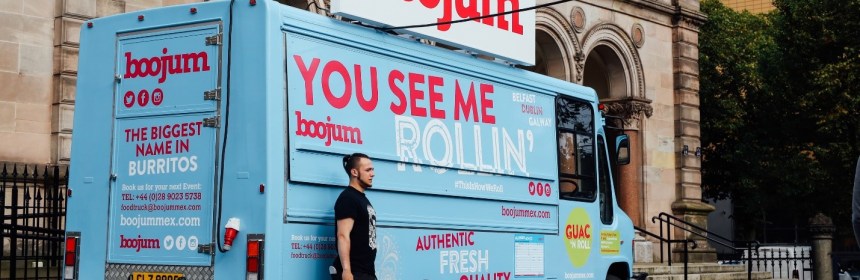
The company has not only been opening up new stores but has been exploring other possible ways to maximise its growth. In 2016 Boojum teamed up with Deliveroo so that people could order their well needed burrito fix straight to their door. Not only this but they launched their “Boojmobile” to serve college campuses and festivals when burritos are typically that bit harder to access. These developments by Boojum really showcase their understanding of their target market and their ability to exploit the opportunities available to them.

In their financial year 2017-2018 (year ended 23rd April last) Boojum recorded revenue of €18.5 million, a growth of more than 50% from their previous year. They did however record pre-tax losses of just over €650,000. This was due to exceptional costs such as store closures during the “Beast from the East” and delayed store openings. The directors state that “overall, it proved to be a very positive transitional year for Boojum. By the end of the period, the group had a strong foothold in Ireland, new stores were established and management was well positioned to explore new opportunities to drive the business forward”. Boojum has evidently put itself into a very favorable position, one as aforementioned will grant them access to expand on their recent prosperity.

British Burritos:

             Brexit has admittedly been a concern for the company considering its cross-border presence says Maxwell. They are tasked with trading and purchasing in multiple currencies and so they must manage the risks associated with this. Maxwell also states that looking forward they are trying to understand what the impact of a hard/soft Brexit might be on their supply chain and logistics. Despite all this there have been rumours of Boojum targeting Britain in the years to come. Although it is too early to really know whether this will happen or not it would not come as a surprise. I mean where else can you go when you’ve already established yourself so strongly in the Irish market and you’re still hungry for growth.

The Business Benefits of Participating in the Fight Against Climate Change

Ellen Quigley

climate-change-money_1_orig

The science behind global warming, and the general trend of climate change, was first discovered by an amateur scientist some 81 years ago. Since it was widely accepted by scientists as being a side effect of human activity in the midst of the 20th century, numerous international treaties and protocols have been agreed upon in an attempt to reduce global greenhouse emissions and waste.

We, as individuals, have been told to ‘reduce, reuse, recycle’ and to cut down on our energy use in an attempt to reduce the negative impacts of human activity. Unfortunately, at an individual level, the impact of our attempt to reduce emissions is relatively small. A recent study published in the journal of climate change revealed that just 90 companies produce a whopping 63% of man-made global warming emissions. Numerous studies have revealed that the fight against climate change could be boosted significantly at a macro level if businesses, who produce the wasteful products we as consumers use, actively made an effort to change production habits, alongside the actual products they sell.

In recent years, the Irish government has introduced more stringent regulation on how businesses should operate in an eco-friendly manner, such as fining businesses for disposing of recyclable waste in non-recycling bins.  However, it appears the general attitude among business owners is that these regulations are necessary evils that must be followed, rather than beneficial rules for the business and society as a whole. A recent survey conducted by Bord Gáis through RED C revealed that half of Irish businesses do not have a formal environmental policy, and that only 40% of businesses encourage employees to be energy efficient in the workplace. When the numerous benefits to businesses of actively participating in the fight against climate change are considered, it’s difficult to understand the apathy of Irish business owners in combating waste and pollution.

In introducing waste reducing methods, businesses save big on costs. Waste reduction can be implemented in all stages of the development, production and sale processes, as well as reducing packaging used on the finished product. The most significant example of this can be seen in Nestlé, who in 2014 removed 175 tonnes of plastic packaging from their Easter eggs. This reduced production costs for the firm significantly, whilst also aiding in the company’s image in the public eye, as the move attracted significant publicity from most major news outlets.

Reducing emissions throughout a firm also has significant benefits. When M&S in the UK introduced its “Plan A” sustainability programme in 2007, it was believed that it would cost more than £200m in the first five years. However, the initiative had generated £105m by 2011/12 according the company’s annual report. Many industry leaders such as Tesco and Sainsbury’s are now following suit, and have now committed to introducing environmental impact programmes, not out of the goodness of their heart, but in order to increase profits and reduce their costs.

Coupled with improving a firm’s image among consumers, the explicit benefits of reducing costs and increasing revenue in the long term should be enough to drive businesses to introduce methods of reducing their environmental impact. By employing waste and emission reducing methods, business can help lead the global effort in the fight against climate change

« Older Entries Recent Entries »