Tag Archives: featured

JMK Consulting: A Trinity Start-Up Focused On All Things Pandemic

After the pandemic took hold and thousands of business were facing forced closure due to government restrictions, JMK Consulting was set up with the aim of helping businesses traverse the ever changing landscape of COVID Payments, Business Restart, Restart Plus Loans, Grants and supports. JMK Consulting also advises businesses on Employers PUP Payments, Employee / Customer COVID Protection, training and responsibilities for the duration of the pandemic, which will be with us for the foreseeable future.

The JMK Mission Statement is “To help business remain and recover during the largest global medical and economic crisis in a century while [their] vision is to act as an enabler for businesses now and in the future.”

The Team

The JMK team consists of Joseph Keegan, Principle Consultant, who has 25 years experience in Researching and Consulting on IT Systems and Technology Grants through JMK Computer Support Services, dealing with Manufacturing, Services and Academic Industries. Along with three recent IT & Project Management degrees he has also just graduated from Trinity Tangent, Ideas Workspace Programme, Postgraduate Certificate in Creative Thinking, Innovation & Entrepreneurship. Mr. Keegan is currently attending the E-Labs Innovation Programme with Trinity College Dublin (TCD) Tangent, in conjunction with University Medical Centre Groningen (UMCG) and EIT Health WHO.

Ray Crean, Principle Researcher, who also shares the same BSc (Hons) in Information Systems and Postgraduate Certificate both from Trinity College Dublin and has wide experience in Corporate Compliance and Board Level Membership.

Where They Are Now

JMK have successfully consulted on the reopening, staffing and grant aiding of two hospitality businesses to the tune of €50,000, both of which are now starting to gain a following and traction again, despite the recent risk of not being able to open again, at great loss to the owners and staff.

With the movement of government restrictions to Level 5, JMK are now focusing their attention on building up their knowledge base as to how to enable businesses to reopen in the future.

Plans For The Future

Given the global acceptance that the pandemic will remain relevant for at least another 12-18 months, JMK client offerings will be even more important and they intend to continue to provide a non-biased point of view in every respect of maintaining businesses through these unchartered waters.

The long-term goal for JMK is to expand into all industries and become a business of excellence with regards to the ‘new normal’ of what they see becoming the “Hybrid Economy both for Business Owners and Employees” when all of this passes.

Get in Touch

Demi’s Basic Business Questions: What is Economics?

Welcome back to college and the first of “Demi’s Basic Business Questions” for this academic year. This week we’re going to be taking a look at uncovering one of the various “business” subjects and make them a mystery no more. Who knows? Maybe knowing the difference between all of them will encourage you to join me in my Intermediate Economics module this semester or go for that Big 4 Assurance internship position.

The textbook definition for Economics is the study of how society uses its scarce resources. What are our scarce resources you may ask? Our money is scarce. Our time is scarce. Land is scarce. So much is scarce. Economics, in studying our choices, is studying human behaviour; Economics is a social science and therefore it is unpredictable. 

Economics is split into two parts – macroeconomics and microeconomics. 

Macroeconomics concerns the big players. That’s our government, that’s the European Union, the World Trade Organisation. Macroeconomics looks at how these big players make decisions in relation to their money. It studies the benefits of international trade, it suggests metrics for measuring how well the economy in a country is doing (GDP, GNP etc. etc. ) and reminds us that the solution is not to print more money. Microeconomics looks at how businesses make decisions in relation to money and how they interact with consumers. 

Microeconomics has a very strong focus on individual behaviour. It makes you open your eyes a bit too. Take for example the law of diminishing marginal utility. It tells us that when you eat several chocolate bars in a certain period of time, let’s say an hour, it gets to the point where eating subsequent bars is less satisfying. Practically, it gives us a textbook evidence for why we instinctively know when to “save it for later”. It also talks us through how hand sanitisers could cost up to 16 euro at the start of lockdown. Supply and demand. As demand increases, price increases. Prices are rarely based solely on the worth of a good. Microeconomics teaches us about perfect competition and how if you increase the price of your oranges on your Moore Street stand, you’re in trouble.

Working as an economist can mean so much. It can mean devoting yourself to academia and producing memorable work like “The Economics of Happiness”. It can mean working within a tech company and advising on how the company can work best to maximise their profits while in competition with other sellers. Economists can work in economic think tanks, predict trends such as unemployment and recession. Economists can advise the government on their spending (Budget 2021 anyone?). In short, economists can do a lot. 

To conclude, Economics is quite cool.

If you have any basic business questions you are interested in me tackling, please do not hesitate to send me on an email: dadenira@tcd.ie

Yours in Learning,

Demilade

Ireland’s K-Shaped Recovery: Will The Rising Tide Really Lift All Boats?

“The Chinese use two brush strokes to write the word ‘crisis.’ One brush stroke stands for danger; the other for opportunity”.

John F. Kennedy famously drew on this aphorism throughout his presidential campaign in 1959 and 1960. In an era of great uncertainty, the US of the 60’s faced the ominous dangers presented by war and nuclear threat. Comparatively, modern-day Ireland faces the daunting prospects of economic collapse and widespread poverty in the wake of COVID-19. Despite early hopes for a V or U- shaped recovery, a dual-track K-shape is emerging as the most likely recovery path from the current pandemic-driven recession, if recent Central Bank reports are anything to go by. Just like the Chinese writing of the word crisis, the diagonal strokes of the letter K represent two parts of the economy which are experiencing vast performance differences in the current climate. On the upward brush stroke lies well educated and skilled people employed in those industries emerging relatively unscathed, if not stronger, from the opportunities presented by COVID. Conversely, on the downward brush stroke of the K sit less-educated workers generally employed in old-line industries, such as tourism and hospitality, which will likely experience the repercussions of the crisis for years to come. Here’s what the K shaped recovery means for Ireland, how it will shape economic inequality, and how the government may try to counteract the economic and societal divides which it causes.

Constitution of a K-shaped Recovery

A K-shaped recovery takes place in the aftermath of a recession when different sectors of the economy begin to recover at different speeds, in different periods, or to different extents. What differentiates a K-shaped recovery from others is that it represents the track of separate disaggregated economic variables in relation to each other, such employment in different sectors or various income levels across society. In contrast, traditionally shaped economic recoveries, generally the distinct shapes of V, U, W, I, and L, detail economy-wide aggregate macroeconomic variables such as Gross Domestic Product, national employment rates, and inflation.

Ireland’s Twofold Recovery

On the surface, it seems as if Ireland could have one of the most exaggerated K-shaped recoveries globally. The recent Central Bank report highlights that the export-led sectors of the economy, spearheaded by IT and Pharma, are recovering at a quick rate, if not booming, while others such as hospitality and aviation continue to contract and bear the brunt of the crisis. This divide is reflected in the contrasting disaggregated economic variables we are currently seeing across different sections of society. The general shape of such differing performance levels across various sectors of the economy echoes the branches of a letter “K” when drawn together, with one declining and the other rising.

Outwardly, it appears that Irelands’ current economic outlook is not as bleak as was predicted in the pandemic’s early stages. On Friday, the Minister for Finance Paschal Donohoe announced that a general government deficit of roughly €21 billion is now forecast for this year: a gloomy number no doubt, but one which has exceedingly improved upon earlier forecasts of €30 billion. However, under further inspection, it is clear to see that Irish multinational exports are not only shielding the economy from the worst of the crisis, but also masking the growth in societal inequality which increases with every day passing day of the pandemic. As Gerard Brady, the chief economist with Ibec, said; “It’s not just a K-shaped recovery for businesses but households as well,”.

Fuelling an Unequal Society?

The Labour Force Survey or Quarter Two 2020, released by the CSO in the final week of August, revealed that employment in Professional Occupations had grown by 7% in July 2020 in comparison to July of last year. Furthermore, employment in Technical and Associate Professional roles grew by 10% in the year to Q2 2020, while Financial, Insurance, and Real Estate occupations increased by 17% in the same period. In comparison, employment in the blue and pink collar sectors has experienced vastly different fortunes during the same period. Employment in the Accommodation and Food Services sector fell by 30% in the year following July 2019, and by 12% in the Construction sector in the same period. Factory work and Skilled Trade employment also fell by 10%, while Sales and Customer service positions decreased by 11%. As Brady remarks, “People who have worked remotely tend to be higher educated professionals. The people who are going to lose or have lost in terms of employment are lower paid, younger workers and workers with fewer skills, training and education.”

Shrinking the Disparities

Ultimately, the government’s ability to bridge the divides presented by COVID depends largely on forces that lie outside the realm of their control. The longer the crisis continues without an adequate vaccine, the more businesses that will close their doors. An increasing number of workers will be left redundant with only their savings and social welfare to rely upon, likely to result in large scale debt across segments of society. With the prospects of an emigration safety net mostly limited in the current international climate, profound societal scar tissue will likely be felt for years to come. If the government hope to have any chance of combatting the two-speed recovery through export-led growth, they must ensure that those workers on the upward brush stroke of the K recovery dispose of their incomes in local economies which have taken the brunt of the downturn. However, to achieve this, Budget 2021 must utilise the correct channels to get these economies and their resources back in motion. A treacherous few months await the government if they are to ensure that the pandemic doesn’t split society in the same way it has divided the economy.

How an Irish Med-Tech Company Could Change the World

By Evan Henry

When it became obvious that COVID-19 was to utterly change how we live, few would have predicted that a company from Galway could play an instrumental role in returning life across the world to normality. Aerogen, an Irish medtech company, produces a drug distribution system that delivers medicine through aerosols in acute hospital settings. John Power, Aerogen’s CEO, formed Cerus Medical in 1997 when he recognised a major gap in the technologies used to deliver drugs in hospitals. While life-support machines were among the most advanced medical technology used in hospitals, the drug-delivery systems that assisted these machines were developed over fifty-years ago. Power believed there were better ways to target the delivery of drugs, and it was common knowledge that drugs are efficiently administered by ingestion through the lungs. Cerus Medical merged with Aerogen Inc. in 2000 and launched its first nebulisation product, the Aerogen Pro shortly afterwards. Twenty years on and the company exports to more than 70 countries and their products are used in 60 of the top one-hundred hospitals in the world, benefitting over ten million patients. Its clients include Medtronic, GE Healthcare and Philips Healthcare.

Aerogen and COVID-19 So Far

Aerogen was overrun when COVID-19 broke out, given the huge demand created for ventilators by the respiratory illness. In fact, Aerogen’s products were in greater demand  than those of competitors because they are the largest producer of closed-circuit nebulisation system devices on the market. A closed-circuit nebulisation system is one that delivers gaseous drugs to patients while leaving ventilation uninterrupted (Medical-aerosols), ensuring that healthcare workers are not exposed to any gases exhaled by the patient (patient-generated Bio-aerosols). Closed-circuit nebulisation devices are far safer and more efficient than conventional nebulisation devices. Aerogen is also working with various hospitals and research groups to adapt ventilators unsuitable for COVID-19 patients. Along with this, the company is involved with more than 20 drug companies and research institutions that deliver antivirals and drugs to patients in ICUs. Power has predicted that Aerogen will move around four million units this year, up from two million in 2019. But despite the outstanding role played by Aerogen in the treatment of COVID-19, the delivery of its cure could be the company’s true magnum opus. 

An Emerging Alternative to Liquid Vaccines

The race for a COVID-19 vaccine has left the pharmaceutical industry in a frenzy, with dozens of companies and research groups competing to produce the immunisation treatment. While a vaccine could potentially be produced by the end of 2021, the timeline is still unclear. The only certainty surrounding the vaccine is that demand for it will exceed supply, likely by a substantial margin. However, Aerogen claims to have the solution to this problem. On RTÉ’s The Business programme, Power revealed that Aerogen is also working with “a leading [unnamed] pharmaceutical company” to produce and distribute an aersolised vaccine. If successful, this will reduce the quantity of dosage required per patient, because drugs ingested through the lungs are generally absorbed more efficiently by the body.

How would aerosolisation address the supply-demand inequity that will occur when a vaccine is finally approved? The inequity will be caused by two things: an insufficient number of doses and an inability to accommodate massive numbers of people gathering to seek vaccination. Should Aerogen’s efforts bear fruit, they will provide meaningful solutions to the issues facing both sides of the market. The first piece of the mass vaccination puzzle Aerogen hopes to solve involves providing enough doses to meet demand. The company predicts that their partners will produce around 500 million liquid doses by the end of 2021, which is a far cry from the amount required to eradicate the virus. However, if a liquid vaccination can be aerosolised, Aerogen predicts that only a fifth of the amount of medicine will be required to treat the patient. If their estimates are accurate, the result would be two and a half billion doses available by the end of 2021. This number will not result in universal immunisation, but it would nonetheless reduce the virus’ rate of spread. The outcome would be fewer new cases, fewer deaths and reduced pressure on healthcare systems worldwide. However, from the initial solution to vaccine shortages springs another challenge: distribution. How can two and a half billion people be vaccinated in a safe, timely and cost-effective manner? Speed of delivery is imperative the alleviation of not only suffering, but also of pressure on healthcare systems. Aerogen claims to have found the answer to this inevitable complication.  The company has developed a station for the aerosolisation of a vaccine which will allow patients to be vaccinated in a quick and orderly fashion. If the station is employed, their estimates, based on data collected from Chinese COVID-19 treatment procedures, predict that 2.5 billion people could be vaccinated in 39 days if ten-hour shifts are worked at 55,000 centres. Such rapid and systematic delivery of a COVID-19 vaccination is as much as anyone could hope for.

Can It Be Done?

The size and scale of Aerogen’s ambitions are clear. They hope to have roughly one-third of the world’s population vaccinated by the end of 2021. Of course, any discussion of a COVID-19 vaccine and its distribution is a mother lode of suspicion and further questions. Will a vaccine even be produced at all, never mind by the end of 2021? If so, can it be aerosolised? Will aerosolisation really require only a fifth of a liquid dose’s quantity? Will aerosolisation prove to be more or less effective than liquid vaccinations? Can other countries work as efficiently as the Chinese in their administration of a vaccine? Will the vaccine be affordable? All of these questions raise valid points and will undoubtedly be the subject of future debate. The honest answer to most of them for now is that we simply do not know. What we do know is Aerogen is one company making substantive strides towards returning life to something like its pre-COVID configuration. Time will tell us whether or not it succeeds.

EthiCart: The Trinity Start-Up Focused On Promoting Sustainable Shopping

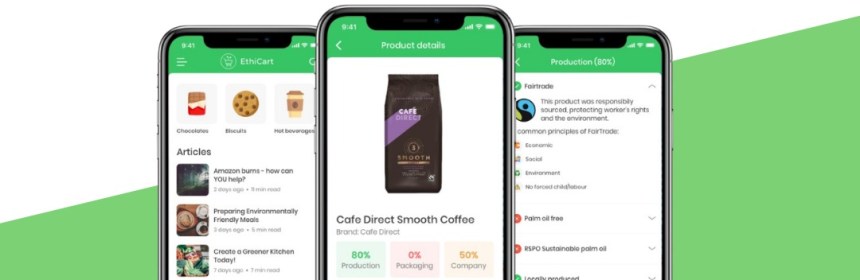
EthiCart is a user-friendly app that provides consumers with easily digestible information about the sustainable or ethical attributes of food products they have selected by simply scanning the product’s barcode. Amongst other educational features, EthiCart removes the confusions around the many different certifications on packaging by explaining these clearly, thus enabling their users to become more conscious and educated consumers.

EthiCart aims to empower the growing community of people who want to shop sustainably and buy products aligned with their values. EthiCart offers quick, easy to understand information, and suggests more sustainable alternatives where possible, helping you become a more conscious consumer. EthiCart is committed to making sustainability simple.

The Team

EthiCart’s founders are Trinity students Laura Brennan and Lara Páircéir. Laura is a final year Computer Science & Business student and Lara is taking a year off books from Sociology & Social Policy. They both share a passion for sustainability and social entrepreneurship.

They participated in Tangent’s LaunchBox in the Summer of 2019 and have since been featured in ‘Ireland’s 30 under 30: Best and Brightest Young Entrepreneurs’, awarded the Blackstone LaunchPad Summer Fellowship and are finalists in the Irish Student Entrepreneurship Forum.

Where They Are Now

EthiCart have launched the first version of the app in Trinity this September, starting small with the products supplied on campus available on the app. The homepage of the app includes blogs, articles, recipes etc. to keep their users informed and engaged. They also have lots of fantastic tips & tricks for what to look out for when shopping sustainably, which anyone can avail of, and some handy Trinity tailored features. Click here to download now!  

Plans For The Future

Small acts when multiplied can transform the world. EthiCart is looking forward to seeing their user base grow by scaling into more mainstream supermarkets so that they can get as many people shopping sustainably as possible.

Get In Touch

EthiCart believe that when sustainability is mixed with enterprise and an amazing community real change can be achieved. Follow their growing online community @ethicart_app on Instagram and Twitter.

« Older Entries Recent Entries »