Author Archives: TBR Team

THIRD PLACE: Navigating the AI frontier: How is Artificial Intelligence Shaping the Future of FinTech? 

Grace Walsh

Introduction 

In this essay, I aim to outline the role of artificial intelligence in fintech’s future, through examining what both fintech and artificial intelligence and their relationship in the finance  industry.  

What is Fintech? 

Fintech, financial technology, is first and foremost an example of the financial world’s  tendency to use unnecessary jargon and abbreviations, but in reality, is a term used to  describe everyday tools used in a myriad of global markets. An intimidating word to the  untrained eye yet exemplified by Revolut, tapping a phone to pay for something, buying and  selling, anything online and sending or receiving money from others are all examples of  fintech. Becoming an increasingly cashless world (Sprout on Dawson Street doesn’t even  take cash) means that fintech is being used on a wider scale. It is innovative and  transformative and has revolutionised the way money is spent therefore consumption and  hence has deepened global economic integration. (Stephanie Waldon, Doug Whiteman, 2022) 

Innovation in the world of finance has been a concept around for decades, although  the rate of change now is much faster than it was before. Changes in the financial world are  hard to keep up with and it can be difficult for regulators and policymakers to understand the  full effects of these technological innovations. Companies like Stripe, make money off  transactions and are therefore making money off people spending money similarly to PayPal. People can now also gamble online and are reminded with colourful and enticing  notifications that its time for them to return to the app and give up more of their money to the  hands of fate (attached to a man named Paddy Power).  

Firms in the financial industry facilitate transactions across markets, this behaviour  has become increasingly simple and accessible in recent decades with the emergence of  companies, like those mentioned above. 

What is Artificial Intelligence? 

Over the past decade AI has made significant developments and is becoming increasingly  accessible and useful in all areas of life; including finance. The IMF claimed that AI would  have a larger impact on the financial sector than COVID-19, in 2021, a shocking estimation  at the time, but now proving to be true. (Boukherouaa, AlAjmi, Deodoro, Farias, Ravikumar,  2021). The introduction of AI through sources like ChatGPT, has changed information access  forever, to a point where anyone can ask it to explain something to them as if they are a child,  in simpler terms than most websites, books or academic papers. People can learn about more  things in a way that suits them and far quicker than before. It took ChatGPT a mere five days  to gain one million users which took Instagram almost two months to reach. (Dave Ver Meer, 2024). Google’s revenue generated via online advertisements has reduced by over 30 billion  US dollars since the launch of ChatGPT according to Statista. It is no doubt that AI means  greater access to information which may help people make better investments and ensure  markets are efficient yet it also has the power to sway opinions, depending on the prompts it  is proposed it may play a role in confirmation bias. Nonetheless, it will change the future of  finance, for better or for worse.  

Potential benefits  

The world of AI has changed methods of information access forever. With this change in  financial markets, information access and communication is also changing, which can affect the financial sector. As seen in the infamous GameStop incident whereby Reddit was the  platform used by masses of day traders who determined the fate of wealthy short-sellers. AI  can now act as advisement in terms of investment decisions or help in creating a budget based  on personal goals and needs. AI has the potential to serve as an inexpensive financial advisor,  whether it is a good one or not is up for debate but regardless its influence exists and can only  grow from here. (Gomber, Kauffman, Parker and Weber, 2018).  

AI is a useful tool which can use financial and economic models, variables and  studies to predict and estimate macroeconomic changes in an economy. This means it is a much more flexible tool than using individual models of examination on the aggregate  economy or performance of markets. AI’s access to new data sources that other models may  not consider such as data uncovered through social media and many other previously ignored  variables. (Boukherouaa, AlAjmi, Deodoro, Farias, Ravikumar, 2021). AI uses machine  learning (ML) and deep learning (DL), which are the tools it uses to translate data into  knowledge that it can use to draw conclusions to certain questions or blend with other 

knowledge that it has previously attained. They are the key traits of AI which allow it to  operate as a useful tool in the finance industry, in the form of data analysis and forecasting.  (Plummer, 2024) 

In some areas of the financial sector including investment banking fintech is the  backbone of its operation. AI offers new opportunities for reaching new market participants,  through the increased accessibility as well as a new form of customer service via the AI  chatbots, hence reducing investment banks costs and increasing its efficiency. (Boukherouaa, AlAjmi, Deodoro, Farias, Ravikumar, 2021). These uses of AI in finance, as a fintech tool  reduce the amount of human contact drastically and significantly streamline the financial  institutions normal practices. The use of fintech and AI in the banking sector is a slowly  developing relationship in most cases due to regulation although there has been, increased  adoption of chatbots as a form of customer service and ATMs and online banking are also  forms of fintech. Through the use of other forms of fintech such as banking apps or online  shopping, machine learning can then be used through machine learning as a component of  creating forecasts about the future of economic stability and financial markets. There is the  potential for banks to use it as a method of risk assessment and credit decisioning by  assessing an individual’s financial history along with other considerations to determine a risk  level. (Plummer, 2024). In a similar way, this data can be used to create personalised  recommendations to customers based on their transactions and interactions with fintech.  

Potential Risks 

This form of data access, as mentioned above through social media or other streaming and  algorithmic services may have negative effects on financial markets as it is difficult to  regulate privacy in this area. As seen in recent years algorithms, social media and even  notifications play a role in politics, as seen in the case of Cambridge Analytica where debates  on data breaches during the Trump Campaign in the U.S. came to light. (Tett, 2017). The data  acquired may also be incorrect and create errors within AI responses to certain questions or  dilute the reliability of it as a source. (Boukherouaa, AlAjmi, Deodoro, Farias, Ravikumar,  2021) The reliability of AI on accurate data is a vulnerability which requires regulation and  supervision, as well as methods of intervention in preparation for crises. It poses ethical  issues as it already has built-in biases and tendencies, if stereotypes and generalisations exist  in data, social media or in anything which AI uses as a source then the same ideology is  absorbed by AI. Since the Global Financial Crisis of 2008, there have been much higher  levels of financial regulation in the banking and non-banking sectors worldwide. The 

development of technology sometimes seems as though it is happening first and the scramble  to come up with policies and regulatory requirements happens after. While AI creates new  challenges for regulators and policy makers it can also be used as a tool for both. It is being  used more and more as an integrated part of a system to detect fraud, money laundering and any other financial crimes which may exist through its accumulation of data about  transactions and patterns of behaviour. (Plummer, 2024) 

Future of AI as a Part of Fintech and Conclusion  Technological innovation has been the key driver for growth in almost all modern, open  economies and hence the pace of innovation is growing faster. Fintech developments are  disruptive to the financial industry, the days of phoning a stock broker are over, and the same  tasks can be fulfilled from anywhere at any time. The evolution of the financial industry from  the introduction of online banking and shopping to now the incorporation of AI. (Gomber,  Kauffman, Parker and Weber, 2018). The use of AI in finance will no doubt lead to further  global integration of markets and economies, increasing the vulnerability of the global  economy to a rampant economic crisis. Regulation and policymaking must coincide with the  future of fintech. AI has only begun to change the financial sector, it will continue to expand  and become more accurate and useful as it becomes integrated into banking systems and  models. It can help understand customers better, increase productivity and market  participation, give better access to information which (if correct) will improve market  efficiency, prevent fraud, reduce costs for financial institutions and make the overall world of  finance more accessible. (Plummer, 2024). With all these benefits comes questioning around  the ethics of its use, the potential of data breaches through ML and DL. The future of AI in  finance is unknown, and will take years of understanding, regulation and integration before it  can be used optimally and safely.

SECOND PLACE: Navigating the AI Frontier: How is Artificial Intelligence Shaping the Future of Fintech? 

Gabi Svobutaite

Introduction: 

Contemporary advancements within the spheres of Artificial Intelligence (AI) are rapidly reshaping  the financial services industry by revolutionizing operations through increased security, boosted  innovation, and accelerated digitization. Artificial Intelligence is particularly pervasive throughout  the fintech industry, automating processes which formerly required considerable time debt and a  sizeable labor force. The influence of AI may be seen beyond simply advancing the current  paradigm of financial services, it is furthermore facilitating the growth of future innovations and  sustainable business models that were previously deemed unimaginable.  

This paper seeks to provide a comprehensive overview and analysis of AI and its advancements in  fintech through a multifaceted approach. Firstly, this paper provides a background on financial  technologies and the areas of such which saw the most growth at the hands of AI. Secondly, this  paper discusses the societal impacts of increased AI use in fintech. Finally, this paper details the  extent to which and how AI is shaping the future of sustainable banking models. 

Fintech: What is it? 

Fintech refers to an emergent branch of financial services where finance and technology merge. It  encompasses a new era of technology which uses specialized algorithms to digitalize fundamental  financial functions which affect how consumers store, spend and save money. Fintech also impacts traditional investment approaches, having established cryptocurrencies such as Bitcoin as a major  player in the world of trading. The term “fintech” applies to a vast variance in innovations regarding  consumer transactions, whether it be developments in mobile banking (MB) or managing  investments through an online brokerage platform.1 

The fintech market may be segmented by four major consumer classes; (i)business-to-business  (B2B) for banks, (ii)clients of B2B banks, (iii)business-to-consumer (B2C) for small businesses, and  (iv) consumers. The increased data security, digitalization and analytics precision which fintech allows for has enabled the aforementioned user parties to interact and collaborate with a new level  of efficiency. 2 

The Fintech Surge: 

The fintech sector saw staggering rates of growth in the latter half of the last decade, with venture  capital (VC) entities investing $19.4 bn into fintech startups in 2015 and an astonishing $33.3 bn in  2020. The Covid 19 pandemic furthermore brought about an era of mass digitalization, causing a  whopping $92.3 bn boost in fintech funding, as well as an expected deal activity increase of 19%.  This upsurge in investments proved to be short-lived, however. Declining geopolitical and  macroeconomic conditions in 2022 provoked a destabilization of the global business environment,  leading to fintech funding returning to standard, pre-surge levels. This devaluation, although  expected, caused many fintech companies to lose vast amounts of capital, and quickly. Venture  capital funding suffered a decrease of $459.6 bn in 2022 from $683.1 bn in 2021. Total investments  in fintech were additionally faced with a 40% decline following this, now sitting at $55 bn as  opposed to $92 bn in 2021.3 

Though the fintech sector still faces many obstacles in the future, there are also many potentials that  have not yet been fully realized. Forecasts for the development of AI technology point to a stable rise in sophistication, thus leading to a steady rise in popularity and use as opposed to more  traditional banking practices. Fintech’s will continue to profit from the dramatic shift and integration  of AI in the banking sector, the quick uptake of other emerging digital technologies, and the global  expansion of e-commerce, especially in developing nations.4 

ML and AI Chatbots: Leading Areas of Growth 

Machine learning (ML) is an emergent area of AI in fintech which utilizes data reading algorithms  and software to better analyze and individualize services provided by financial institutions. ML is  revolutionizing how Big Data is assessed and trading market risk is predicted, without the need for  human employees.  

With the rapid growth and improved computational capabilities of modern technologies, large  amounts of data are becoming more readily available for economic and governmental entities to utilize. Analyzing this data, however, would require vast amounts of capital, time and people  resources. Therefore, companies and governments alike have turned to alternative methods of  analysis like AI to identify, process and study Big Data.  

ML uses intricate coding and algorithm models to source smaller data sets from the generalized pool  of Big Data, and thus create predictions which stem from the data sets identified. The algorithm  then uses recognition technologies to identify patterns for learning and remembering data, which  allows for abnormal activity and pattern change recognition when introduced to new data sets. 

Machine learning thus has become a large player in various industries such as banking and investing, or marketing and fraud regulations. Financial sectors may use ML to recognize trading opportunities  or identify market risks for loans and investments. Marketing and advertisement industries can  utilize machine learning algorithms to learn about their consumer’s online media activities to provide  them with the best suited and individualized content recommendations.5 

AI Chatbots have spearheaded the digitalization of customer service in the domains of financial  service and fintech industries. E-commerce firms and startups now employ AI via the means of  virtual assistants and chatbots to offer immediate and around-the-clock assistance to their  customers. Through using complex algorithms and data recognition software to analyze individual  customer transaction data, the aforementioned AI-powered virtual assistants can offer customized  and instant advice to each customer.6 

AI in Fintech: Societal Impacts 

The integration of AI in the spheres of fintech and the financial services industry has and continues  to have an extraordinary impact on society both on a micro and macro level. Firstly, through the  introduction of mobile banking (MB) and other e-commerce platforms, AI has allowed for fintech  to acquire a far greater consumer base, enabling individuals from disadvantaged and thus  underbanked regions to manage their finances effectively and with ease. According to a 2021 study  by McKinsey, the demand for e-commerce structures is notably higher in developing countries;  Africa was home to virtually half of the world’s total MB accounts, approximately 800 million users  were estimated. Fintech with its adoptation of AI had additionally served to further overall economic growth. AI has allowed fintech to establish new competitors within the financial industry,  thus driving prices down and allowing for increased choice within the market.7 

However, the growing popularity and mass usage of ML, MB and virtual advisory services has  contributed to a wide scale trend of employee layoffs. Several tech firms have already quoted AI as  the reason for their staff layoffs and reconsideration of tech graduates for recent hires as Silicon  Valley, Big Tech and commercial banks seek to keep up with recent AI advances. One of the  principal ways to pivot business activities to improve key operating metrics and hit the bottom line is  reducing headcount. Cutting headcount expenses to maintain profitability whilst backing  technological innovations is especially prevalent in the current climate of slowed VC and fintech  funding. Due to the increasingly automized nature of Big Data analytics, the increased consumer  preference of mobile banking systems and e-commerce platforms for capital management and  investment activities, and of course AI-powered virtual assistants overtaking existing financial  advisors in the banking industry, the need for physical employees is becoming increasingly  nanoscopic. 8 

Fig 1: data retrieved from FRED, Federal Reserve Bank of St. Louis. 

Figure 1 shows the fluctuation in US commercial bank employees, a definite decline may be seen in  recent years with a current downward trend visible after 2023.9 

Utilizing AI to Pursue a Path of Future Sustainable Growth: 

AI and fintech have the power to mitigate the largest growing social challenges we face today,  namely climate change and reaching national sustainability goals. Such issues require highly  progressive and innovative solutions, those which artificial intelligence and machine learning systems can produce.  

Sustainable investing is an area which massively favors AI and utilizes it to aid investors in sourcing and analyzing large volumes of new information when considering the risks and opportunities  relating to ESG (Environmental, Social and Governance) investment obligations of companies and  governmental bodies. Additionally, AI algorithms allow for an in-depth analysis of all the  information available about a certain company, which can be an immense and costly task for a  human employee to undertake. This leveraging of AI and ML technologies enables potential  greenwashing companies to be discovered in a far timelier manner. 10 

Conclusion: 

To offer some parting words, there is no doubt that the integration of artificial intelligence (AI) in  fintech has revolutionized ways in which the global majority manages their finances. With its ability  to analyze vast pools of data, predict capital market risks and trends, and provide customized user  experiences, the journey of AI in fintech will undoubtedly continue to evolve, encouraging a new age  of financial innovation. 

FIRST PLACE: Ireland: From Greenwashing to Green Growth 

Chloé Asconi-Feldman

Introduction 

Although the term has been thrown around in recent years as a new buzzword, greenwashing was coined in the 1980s and has prevailed since the 1960s.1 Yet, it is finally due to the Climate Crisis and the ongoing trends of implementing ‘green’ laws, that companies that are guilty of greenwashing are finally being held accountable. Although each country has their own set of standards regarding regulating corporate practices and sustainability, this article will focus mostly on Ireland and the EU. Since many sets of regulations that Ireland follows regarding sustainability are from the EU, it is critical to assess where Ireland stands compared to other countries in the Union, and what this means for the future of corporations in Ireland. 

Greenwashing in an EU Context 

Considered to have one of the most ambitious decarbonisation plans of any country in the world, many companies find Ireland an attractive country to expand and invest in. Yet recent studies have shown that the majority of Irish firms do not meet EU requirements regarding sustainable investments. With few regulations regarding greenwashing until recent years, a survey of 125 financial service firms in Ireland found that fewer than one-third of the companies were fully complying with EU rules around ‘green investments’. In the context of the entire EU, a 2021 report found that around half of the companies audited by the EU were found to have been engaging in greenwashing. Where countries in the EU rank in terms of environmental claims, Ireland does not seem to be paving the way. Countries such as France have seen the most success, implementing seemingly radical laws which could place parties who are found guilty of greenwashing to face prison sentences. France’s Climate and Resilience Law which came into effect in 2021 sets out clear definitions of language relating to the Climate Crisis and enforces strict requirements. In terms of the green bond market, despite its growth, Ireland’s is relatively

small at €28.8bn in October 2022, whereas other EU member states such as the Netherlands reported a green bond market share of €91.5bn. 2 

Sustainable Finance Disclosure Regulation 

The Sustainable Finance Disclosure Regulation (SFDR) was introduced by the European Commission and holds the aim of making it easier for investors to learn about a fund’s environmental, social and governance (ESG) credentials.3 The Financial Services Commissioner Mairead McGuinness considered the SFDR as the first regulation to set rules on how financial market participants must disclose sustainability-related information.4 Since it is considered the first set of standards, the requirements pose a challenge to the industry and regulators, having the Compliance Institute, a Dublin-based body for regulatory and compliance professionals, state that there is still significant unease around the SFDR.5It has caused hundreds of funds to downgrade their ranking in terms of sustainability, notably from having an Article 9 ranking, which are funds that have sustainable investment as their objective, to an Article 8 ranking, which are funds that promote environmental or social characteristics.6 

New EU Laws 

In 2024, there has already been improvement in the EU, with Parliament approving new directives that will combat greenwashing, setting higher standards to improve product labelling and banning the use of misleading environmental claims.7 Regulating sustainability labels will mean that corporations will have to go through an official certification scheme by public authorities in order to use labels such as “environmentally friendly” or “climate neutral”. 8 Alongside this, there will be a ban on claiming that a product has a neutral, reduced or positive impact on the environment due to emissions offsetting schemes.9 What this means for Irish companies is the need to emphasise clarity in their advertising, and remove false claims. It also enforces a standard of transparency that is not currently present within Irish companies. A global study conducted by PwC found that the majority of investors in Irish companies believed that reports regarding sustainability performances tend to contain unsupported claims and contain greenwashing.10 

Green Growth in Ireland 

With the increasing level of importance that the EU has been placing on sustainability and greenwashing, Irish boards of directors have started prioritising potential greenwashing risks and

determining how to eliminate these risks. The Central Bank of Ireland claimed that ESG was one of their main regulatory priorities in 2023, emphasising the country’s quick reaction to the SFDR. Considering the Irish government’s Climate Action Plan aims to halve their national emissions by 2030 and achieve net zero emissions by 2050, many firms are stating that investing sustainably is not only important to comply with the new regulations, but also in order to achieve these national goals.11 The Big Four have all published articles relating to the importance of ESG investing in Ireland, as well as many other firms alike. It seems that despite its past in greenwashing and false environmental claims, there is genuine concern for green growth among companies. Dublin has recently hosted sustainability-oriented events such as the Sustainable Aviation Fuel and Carbon Finance Day, which is one of the largest meeting places for participants in the aviation industry.12 Philip Lee, an Irish law firm, has recently advised different organisations on one of the world’s first Article 6 projects, which is a project that is able to transfer carbon credits earned from the reduction of greenhouse gas emissions to help one or more countries meet their climate targets.13 This example shows initiatives from Irish firms to take on roles where there is green growth and step out of the greenwashing stereotypes that companies and firms once held. 

Conclusion 

Irish companies need to address climate and sustainability issues authentically for several reasons. According to numerous surveys, investors want to know companies’ sustainability strategies and can guarantee that the information provided is reliable.14 Social influence, the EU’s

new regulations, and investors’ needs are all reasons why Irish companies need to prioritise green growth if they want to prosper in the future. So far, Ireland seems to be moving in a positive direction, yet since we are in the early days of this new legislation, it is difficult to come to a fair conclusion. Yet one conclusion that we can make is that the days of greenwashing practices are coming to an end in Ireland, for the better.

Trinity Entrepreneurial Society: Dragons’ Den Recap

Rhea Singhal

In modern society, entrepreneurs serve as catalysts for evolution, driving change through boundless creativity and innovation. They actively seek out opportunities within untapped markets, pioneering products, services, and initiatives. The impact of entrepreneurship extends beyond business; it can reshape perspectives and foster meaningful connections.  

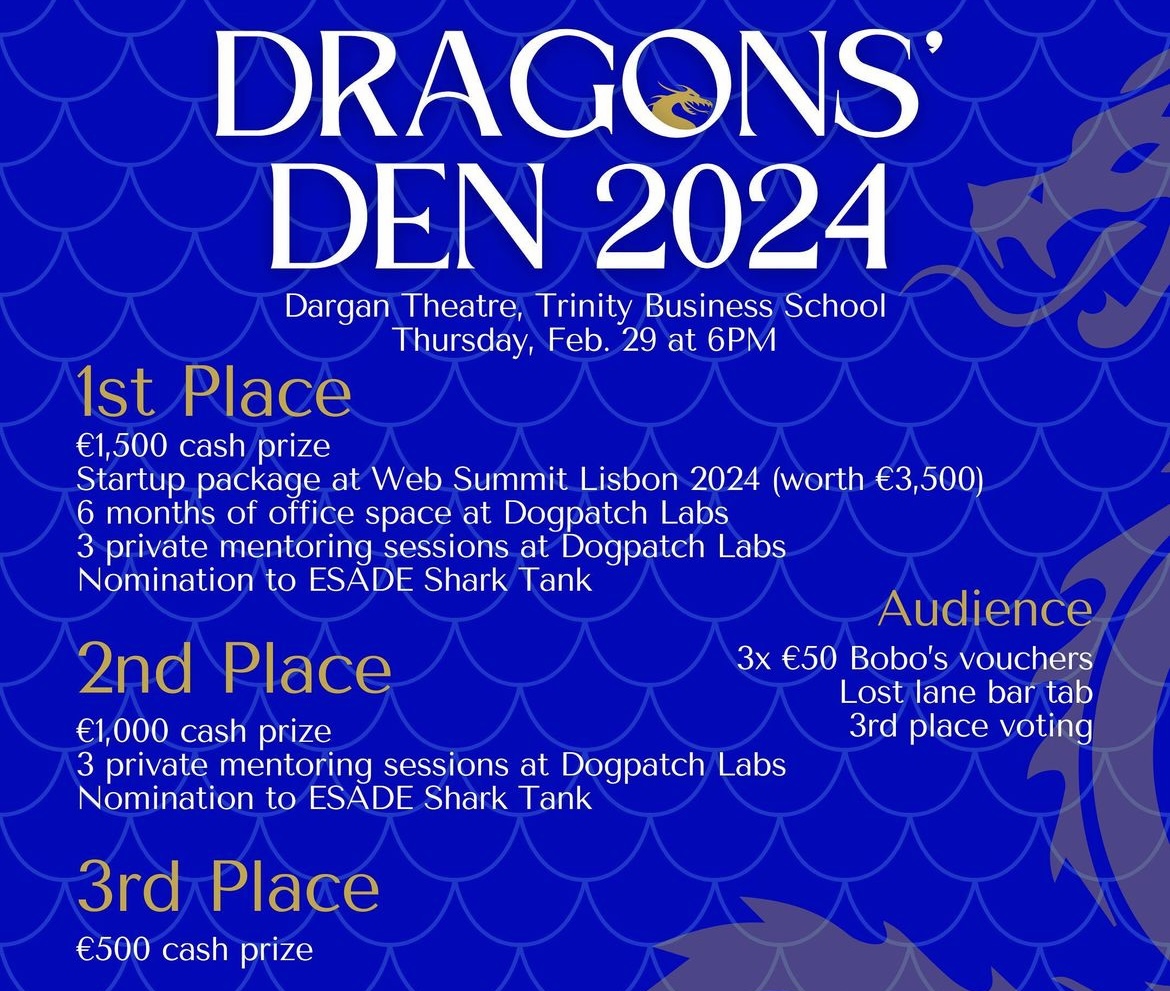
Trinity Entrepreneurial Society’s Flagship event the “Dragons’ Den” competition encourages this very spirit of innovation. The event, held on 29th February 2024, garnered over 250 attendees and also included an intermission pitching competition. The ‘Den’ boasted outstanding prizes up for grabs:

Inside the Den

The overwhelming number of entries are a testament to not only its popularity and continued success, but also to the resilience, creativity, and ambition of Irish innovators. At the event, finalists pitch their ideas to a panel of esteemed judges, “ dragons”,  who are leaders in the business community. The dragons this year were Heather Morris (MD, Founder Talent Accelerator at Dogpatch Labs), Orla Dunbar (Director at Deloitte Consulting), Keavy Ryan and Darren Nagle (Corporate and M & A partners at A & L Goodbody) and Conor Joyce (TES President). Mastering the art of pitching is an indispensable skill for every entrepreneur to be able to present a compelling and convincing case for their venture. It is a dynamic and strategic journey which is an eclectic mix of passion, clarity, and persuasion. 

This year’s contestants brought to the table a diverse array of concepts ranging from ways to simplify business to enhancing social media connections to early detection of life-changing diseases. They had to demonstrate, within a strict time limit, a suave ability for technical integration of their concept with data and convince the dragons that their idea was worth investing in. The pitches this year were exceptional in their data driven presentations highlighting meticulously researched strategies and astute business acumen. In the current business landscape, data serves as a cornerstone for credibility and provides concrete evidence of market potential and feasibility. 

The electric atmosphere and motivated pitchers set the stage for a riveting entrepreneurial battleground. The tension was palpable as the contestants faced the intense scrutiny and relentless questioning by the dragons.

Finalists included:

  1. Saor Water: Saor was born with a clear vision- to challenge the status quo and redefine the way brands connect with people. They offer free recyclable, branded water at events and on the go. Their customers include Mercedes, Roots health foods etc. https://saorwater.ie/?trk=public_post-text
  2. Kish: A digital receipt app which aimed at revolutionising receipt management and organisation. 
  3. SkinAware: An AI based wellness app that aims to integrate personalised care insights to wellness. 
  4. Peak Predict: An app that tracks every aspect of your fitness, catering to sports enthusiasts and athletes.
  5. Tribe: Tribe is modernising the way people drink whiskey with the first of its kind canned whiskey cocktail in Ireland. https://lnkd.in/eEfVBH8S?trk=public_post-text
  6. Rentilia: A service which proposes to be an intermediary for renting equipment. Contact rentiliaofficial@gmail.com
  7. Neurosonic:  A smart device designed to aid in the prevention of strokes through early detection at home. https://www.neuro-sonic.com
  8. Common Ground: An app enhancing social media connections fostering meaningful interactions in the digital sphere. 

NeuroSonic took the win, with Tribe and Saor Water securing second and third place respectively. While the winners went home with prizes, everyone from the competitors to the audience gained inspiration and insights into the nuances of pitching, the inherent obstacles faced by start-ups, and the indispensable art of navigating market forces.

Amazon’s Unfair Play: Exploring the FTC Lawsuit and Exclusive Insights from Dr. Christopher Gopal 

Mariia Kashirina 

Introduction: 

Amazon Inc. is an American multinational technology company ranked the fifth largest in the world by market capitalisation. It positions itself as an online marketplace and is known globally not only for its wide variety of products, quick delivery, and low prices but also for its innovative technology,  efficient supply chains, and data-driven strategies. The company claims to be guided by four principles: a passion for invention, commitment to operational excellence, long-term thinking, and customer obsession rather than competitor focus.

However, when examining the company’s fourth principle,  is Amazon truthfully customer-obsessed rather than competitor-focused? According to the Federal Trade Commission, it is not. 

On 26 September 2023, The Federal Trade Commission, led by Chair Lina Khan alongside 17 state  attorney generals, filed an antitrust lawsuit against the multinational online retail giant, claiming that the corporation is a monopolist that illegally maintains its power through a series of  interconnected, unfair, and anti-competitive tactics.

Why is the FTC going after Amazon? 

Under the current Chair, Lina Khan, the FTC has a more confrontational stance against the influence of  big tech and augmented efforts to break the rooted monopolies held by a few leading firms in sectors like online retail and search engines.

Khan rose to prominence as a legal scholar, primarily through her influential paper in the Yale Law  Journal titled “Amazon’s Antitrust Paradox”.  This pivotal work focused on the concept that consumer  prices were paramount in determining whether a corporation engaged in anticompetitive behavior through Amazon’s lens.  This highly anticipated antitrust lawsuit has just been initiated, with Amazon at its center; the company faces accusations of persistently engaging in unlawful practices that obstruct competition, enabling it to wield monopolistic power. 

According to the lawsuit, Amazon currently dominates the e-commerce sector by dictating prices,  limiting the selection of products, and ensuring that its competitors are unable to gain traction with  buyers and sellers. Its strategies affect an enormous portion of online retail sales, impacting numerous  businesses and millions of shoppers, cementing its stronghold in the market.

The specific allegations outlined in the complaint include: 

• Anti-discounting measures and manipulating other stores into increasing prices

• Forcing sellers to use Amazon’s costly fulfillment service to obtain “Prime” product eligibility

 • Lowering the quality of the user experience through “defect ads”

• Manipulating search results and trapping consumers into paying for Amazon Prime

From here, we can explore Amazon’s role in the competitive market landscape.

Analysis: Amazon’s Supply Chain and Anti-Competitive Tactics

I. Amazon’s Overall Supply Chain and Fulfillment

Amazon’s supply chain process starts with bulk goods dispatched to Amazon Warehousing and  Distribution (AWD) through freight and logistics services. AWD then stores products cost-effectively,  ensuring quick availability at distribution centers. Strategically located warehouses, optimised internally with five storage areas each, enhance product retrieval speed, aligning supply with demand. Goods move from fulfillment centers to customers in the final step.  

Fulfillment is integral to Amazon’s supply chain strategy, and with third-party sellers being responsible  for more than half of all sales made on Amazon, there are two fulfillment options for sellers – Fulfillment  by Amazon (FBA) and Fulfillment by Merchant (FBM).  FBM allows the seller to be in charge of listing  their products on Amazon and handling fulfillment aspects of the process on their own, while with FBA, Amazon takes full control of logistics and customer support while merchants only have to send their  products to them.

Fulfillment by Amazon is one of the central parts of the FTC allegations, as they claim that “Amazon  maintains its monopolies in both customer and seller markets by coercing sellers to use Amazon’s fulfillment service”. Amazon’s fulfillment service allows sellers to fully access Amazon’s substantial  base of shoppers, making it a critical aspect of the marketplace services Amazon offers to sellers.  

While it may seem that Amazon does not force the sellers to use FBA, the ones who will opt for independent fulfillment will have to split their inventory across multiple channels in order to ensure the  next day delivery promised by Prime. Such a strategy artificially stunts the growth of FBM, which prevents competitors from reaching the size necessary to effectively challenge Amazon. 

In addition, it is alleged that sellers who do not utilise the Prime eligibility effectively disappear from the  storefront, making the product almost invisible to consumers, which decreases their sales numbers  significantly.  

II. Amazon Prime 

According to the FTC, Amazon’s internal data reportedly indicates a significant rise in consumer  spending when they commenced Amazon Prime. This surge in spending contributes substantially to  Amazon’s revenue, which reached $35.22 billion in 2022 through Amazon Prime sales. Allegedly, to  maintain these sales figures, Amazon is accused of employing tactics such as deceptive designs to  coerce consumers into recurring subscriptions and making the cancellation process intentionally  complex and lengthy, referred to internally as “Iliad Flow”, drawing parallels to Homer’s extensive epic  poem. These manipulative tactics negatively impact both consumers and law-abiding businesses. 

III. Algorithmic and Contractual Tactics 

It is also alleged that Amazon employs its algorithms to restrict rivals from expanding in the e-commerce  industry by manipulating price competition. A crucial factor for Amazon, these algorithms employ various methods to implement an anti-discounting approach and maintain the perception of offering the lowest prices in the market. 

According to the FTC, Amazon employs its “Competitive Monitoring Team” to monitor the internet for price changes continually. Following that, they utilise this team to enforce new contractual duties and even harsher penalties on third-party marketplace vendors who offer cheaper pricing on other internet stores. An example of such a penalty could be the “Select Competitor – Featured Offer Disqualification” algorithm that has been used by Amazon to enforce its “expectations and policies”. This algorithm removes the seller from the “Buy Box”, where 80%  of all purchases are performed, significantly undercutting vendors’ sales thus forcing them to resist offering lower prices elsewhere.  

In addition, it is claimed that Amazon not only prevents the sellers on their marketplace from offering  lower prices but also has manipulated other stores’ pricing algorithms into increasing prices through  “Project Nessie”, the algorithm whose only purpose is to raise prices for consumers. 

Project Nessie accurately predicted that there was a high chance other internet retailers would imitate  Amazon’s price increases for items they were already making a profit on. It acted at the optimal moment  when the probability of others replicating the price adjustment was at its highest. Through these  manipulations of other stores’ prices, Project Nessie has generated over $1 billion in additional profit for  Amazon from 2016 through 2018, according to their own calculations.

IV. Advertisement and search results 

Additional accusations of unlawful tactics involve Amazon degrading customers’ experience by placing costly, irrelevant advertisements on their platform and skewing search results to favor Amazon’s  products over those of better value. 

According to the FTC complaint, Amazon CEO Jeff Bezos instructed his executives to “accept  more defects” during a key meeting. “Defect Ads” are advertisements that are partially or entirely  irrelevant to the customers’ search. The main idea in placing “Defect Ads” is to nudge the customers  

towards higher priced items. As the space on the platform allocated to sponsored content expands, it  becomes more and more challenging for buyers to find more affordable products. This complicating  factor, in turn, counteracts the effect of inflated prices. 

Despite the compromise between heightened ad earnings and decreased sales due to inferior search  outcomes, Amazon sustains consistent double-digit growth in total sales and hasn’t experienced a  substantial departure of customers to competing platforms.

The decline in user experience doesn’t just end with flawed ads. Amazon exacerbates advertisement concerns by hiding  natural content under recommendation widgets like the “expert recommendation” feature, showcasing  Amazon’s products ahead of others.  Through manipulation of these widgets, Amazon obstructs fair competition against its own products, intentionally concealing details about competing products to artificially boost its own offerings. According to the FTC, Amazon’s ability to conduct this way without  losing a significant portion of customers directly demonstrates its monopoly power.  

Amazon’s response 

In their statement, Amazon responds to the FTC’s allegations by saying that the lawsuit appears to be  misguided and, if successful, would force Amazon to engage in practices that actually harm consumers and the many businesses that sell in their store—such as having to feature higher prices, offer slower or less reliable Prime shipping, and make Prime more expensive and less convenient.

In addition, Amazon argues that its dedication to low pricing, assistance for independent sellers,  Fulfillment by Amazon (FBA), and Amazon Prime are not only pro-competitive but also beneficial to  customers. They plan to fight the case while maintaining its focus on customer pleasure and innovation.  

Criticism of the Allegations 

The main criticism of FTC’s claim is that their allegations against Amazon are misguided. One common  argument is that both sellers and consumers have the option to choose alternative platforms or avenues  if they feel disadvantaged by Amazon’s practices. They can opt for competing platforms like Walmart and Target or create their own distribution networks to avoid reliance on Amazon;similarly, consumers  are not compelled to shop exclusively on Amazon, as they can adjust their behaviour by seeking better  prices or quality elsewhere. 

However, a critical perspective arises when evaluating Amazon’s dominance in the e-commerce  industry. While it may not hold the same level of dominance in the broader retail market, Amazon  overwhelmingly leads the e-commerce sector with a share of 37.6%, followed by Walmart at 6.4%,  Apple at 3.6%, and eBay at 3%.  This context suggests that within the realm of e-commerce, the options  available to both sellers and consumers are significantly limited by Amazon’s dominant market position.  Hence, the argument that they have the freedom to opt for alternatives might not hold true due to  Amazon’s unparalleled presence. 

Another common argument refers to the FTC’s accusation of Amazon punishing sellers who offer  cheaper pricing on other internet stores. In particular, Fortune argues that “sellers offering prices lower  on their websites does not lead to lower prices for consumers, it just allows the sellers to shift the sale  from the Amazon website to their own” and “merchants who attempt this free-riding tactic are the ones  raising consumer prices on Marketplace to try to keep Amazon from making the sale”. 

Although this price tactic might seem effective in preventing free riding by merchants and ensuring the  lowest price to consumers, it still significantly limits competition and innovation in the marketplace. By  enforcing these rules on sellers, Amazon limits the merchant’s ability to dictate their pricing strategies 

and offer better prices on their websites. This, coupled with Amazon’s prioritisation of private label  items over organic content through recommendation widgets, makes it difficult for sellers to compete.  The price parity policy further emphasises this issue, limiting merchants’ pricing flexibility and making it  harder for them to attract customers. Ultimately, these restrictions hinder consumer choice and  undermine the potential benefits that healthy competition can bring, such as lower prices. 

Insights from Dr. Christopher Gopal 

Dr. Christopher Gopal is a well-known figure in the field of global supply chain management, logistics,  and information technologies. With over four decades of experience as a supply chain and operations executive, he has spoken at various international conferences, including but not limited to HBR, IATA,  OECD, and EU Conference on Concentration and Security.  

Dr. Gopal has also held SVP and VP positions in supply chain and operations for major global  corporations like Dell, SAIC, and Unisys, among others. He has written four books on Supply Chain &  Operations, including the latest one titled “Breakthrough Supply Chains: How Companies and Nations  Can Thrive in an Uncertain World”, which was published by McGraw-Hill in June 2023.  

Currently, Dr. Gopal teaches “Supply Chain Management” and “Strategic Cost Management” at the Rady School of Management at the University of California, San Diego. Additionally, he is a member of the  Defense Business Board (DBB), which is a Department of Defense/Pentagon Advisory Body that provides  business perspective advice to the Secretary of Defense and other officials.  

Exclusively for this article, Dr. Gopal shared his opinion on the most pressing topics of the FTC vs Amazon  lawsuit that allows a broader understanding of the ongoing dispute:

First of all, should the Federal Trade Commission go after Amazon? 

Dr. Gopal advocates for the FTC’s intervention towards Amazon. However, he believes the  ongoing lawsuit should not be aimed at destroying Amazon but rather must emphasise the  necessity to employ stricter regulations that would foster healthy competition and prevent  monopolistic practices from being utilised. He points out the prevalent lack of enforcement of  numerous antitrust rules and regulations, indicating a critical need for implementation. He believes that the FTC should actively enforce these regulations upon Amazon to ensure a fair  marketplace and promote a level playing field for all businesses involved. 

Given the accusations, what potential changes or adaptations might Amazon need to make in its operational strategies to comply with antitrust laws? 

Dr. Gopal believes that the most crucial changes that Amazon will need to make are changes in  their pricing models and fulfillment operations to comply with antitrust laws. According to him,  it might be beneficial for Amazon to decouple these services from its own fulfillment network.  

This means allowing suppliers who wish to sell on Amazon to utilise their own fulfillment  services and giving them the freedom to opt for their preferred delivery and distribution  methods. 

At present, some sellers avoid using Fulfilled by Amazon (FBA) because Amazon requires them to  split their inventory across various sales channels. This constraint restricts sellers and potentially  hampers their ability to maximise their sales potential. Instead of imposing such restrictions,  Amazon could empower vendors by providing them with greater flexibility in managing their  inventory across multiple platforms.  

Essentially, Amazon should function more as a platform that facilitates sales rather than imposing its fulfillment services on vendors. 

In addition, he holds the view that the accusations regarding Amazon’s alleged favouritism toward  their private label products within recommendation widgets, along with algorithms that  seemingly exclude sellers from the “Buy Box”, requires immediate rectification. It is evident that  these practices need adjustment to ensure fair competition on the platform. However, there is a  possibility that Amazon might seek alternative approaches to maintain its strategic advantage  despite any corrective actions taken. 

How will these improvements affect operational efficiency and the company’s relationships with third-party vendors? 

According to Dr. Gopal, opting for a change could notably impact efficiency, especially in relation  to Amazon’s hallmark “next-day delivery”. To ensure clarity, if Amazon intends to uphold this  service standard, it should be communicated clearly up front. Yet, sellers should also have the  freedom to specify longer delivery times, aligning with transparency and allowing them to  manage customer expectations effectively. 

In terms of Amazon’s relationship with third-party vendors, transitioning from a fulfillment focused approach to a platform-oriented one will likely attract more vendors. This evolution  would enable vendors to diversify their distribution, not solely relying on Amazon but exploring  other e-commerce platforms. This diversification could reduce Amazon’s monopolistic  tendencies and compel the company to offer more competitive terms to vendors in order to  remain appealing in the market, which would ultimately benefit both vendors and the e-commerce landscape as a whole. 

What is Amazon’s future? Will the FTC succeed? 

Dr. Gopal anticipates a shift in Amazon’s operations post lawsuit, expecting operational  enhancements in the aftermath of legal proceedings. Nevertheless, an alternate viewpoint  surfaces when considering the imminent election and its potential impact on the FTC’s  administration.  

The prospect of a change in the FTC leadership due to the upcoming presidential election offers  a new angle to the narrative. This potential shift in administration might embolden Amazon to  prolong its legal battle, seeking a more sympathetic disposition from the incoming officials.  Hence, the company might persist in its strategic maneuvering, buoyed by the hope of a more  favorable regulatory climate.

While Dr. Gopal foresees some lawsuit outcomes in the near future, he doesn’t expect Amazon  to concede entirely to the FTC’s demands. The company is likely to fortify its position leading up  to the election. 

Interestingly, Dr. Gopal’s conversation with Barry C. Lynn, a liberal American journalist and writer currently advising the Federal Trade Commission on the Amazon antitrust lawsuit, reveals a contrasting perspective. According to him, the FTC is confident in its ability to win on most of the allegations, indicating a strong belief in its case against Amazon. 

Where from Here? 

According to a former Justice Department antitrust official, George Hay, “Amazon has had years — at  least since Lina Khan came to the FTC — to think about this lawsuit and how they’re going to defend  against it.”  Indeed, with Amazon’s lengthy preparation and the FTC’s determination, the stage is set for  a protracted legal showdown. This impending battle signifies just the initial chapter in the FTC’s broader  campaign to dismantle the monopolistic grip exerted by tech giants. As we await the unfolding of  events, the trajectory of this struggle will undoubtedly shape the landscape of the tech industry for  years to come.

« Older Entries Recent Entries »