Category Archives: Uncategorized

Budget 2024: An Economic Analysis
Natalie Kollrack

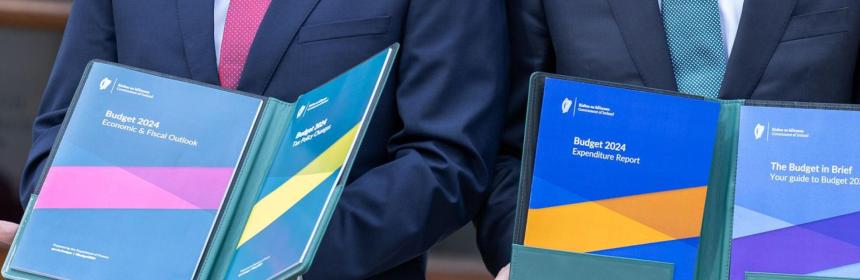
In speeches to Dáil Éireann last Tuesday, the 10th of October, Minister of Finance Michael McGrath of Fianna Fáil, and Minister of Public Expenditure, NDP Delivery, and Reform Paschal Donohoe of Fine Gael unveiled the 2024 Budget. Key themes in this year’s budget included supporting Ireland’s current society and augmenting sustainability, while also considering future implications of increasing public expenditure. The total budget package was to the tune of €14 billion, funded in part by €250 million from windfall corporation tax receipts. Interestingly, the government, boasting a budget surplus of €8.8 billion, would have encountered a €2 billion deficit were it not for the windfall corporate tax receipts. This article provides an overview of the primary provisions and delves into the criticisms raised by economists regarding its potential ramifications.

Housing

Minister McGrath detailed efforts from the government regarding housing – a prevalent issue in contemporary discourse. McGrath announced that homeowners with an outstanding mortgage balance from €80,000 to €500,000 on their house will receive a one-year Mortgage Interest Tax Relief. This will cost about €125 million and will benefit about 165,000 mortgage holders. The Rent Tax Credit has been increased from €500 per year to €750 per year, a temporary tax relief to keep small landlords from leaving the market. Additionally, the Help-To-Buy Scheme, the Vacant Homes Tax, and the Residential Zoned Land Tax are all intended to be extended. Lastly, Minister Donohoe reported that there are plans for 29,000 homes to be constructed by the year’s end, with 21,000 already built.

Finances

Minister McGrath celebrated falling inflation, with an estimated rate of 5.25% for September this year, and predicted a 2.9% inflation rate for 2024. In response to inflationary challenges, McGrath and the Department of Finance have escalated public spending from 5% to 6.1%, even as they anticipate income growth outpacing inflation due to a thriving economy. Their plan is to revert it to 5% as inflation diminishes.

Additionally, the government has also increased personal income tax to support workers and achieve efficiency in the labour market: the cutoff point for the lower income tax bracket has been raised by €2,000 for both single and married individuals. On the wage front, the national minimum wage has been increased by €1.40 to €12.70 per hour.  The Universal Social Charge, or USC, has been decreased for the first time in five years, from 4.5 to 4%, and the threshold for USC will be raised to €25,760. Finally, the government has introduced the Future Ireland Fund, made to support future government expenditure, which will receive a 0.8% investment of GDP annually.

Education & Health

Minister Donohoe has allocated a significant proportion of the budget to the Department of Education. Regarding higher education, he announced a once-off reduction of €1,000 for students qualifying for free fees, as well as payments to help students with secondary education. For the health sector, Minister Donohoe announced additional recruitment to increase healthcare staff, as well as continued investment in public health and vaccinations. To combat smoking, Minister McGrath announced an increased excise duty on tobacco products, raising the price of cigarettes to €16.75, additionally proposing a domestic tax on E-Cigarettes in next year’s budget.

Climate

Minister McGrath has taken steps to address climate change concerns by launching the Infrastructure, Climate, and Nature Fund, which is set to increase to €14 billion by 2030. The fund’s financing includes an annual contribution of €2 million and a share of the windfall from corporate tax receipts. On the public transportation front, Minister Donohoe has introduced funding for cycling, walking, and Greenways infrastructure, with additional fee reductions being introduced to encourage the usage of public transportation. Regarding energy, Minister Donohoe mentioned a target of 80% of electricity coming from renewable electricity in 2030, as households prepare for the cold winter ahead. Additional funding to increase environmental sustainability and to support farmers was also cited. Last but not least, Donohoe announced that approximately half of the income from carbon tax revenues will be reinvested to enhance energy efficiency in homes.

Other

Less prominent but nonetheless important, in the digital sector Minister Donohoe announced funding in the National Broadband scheme, extension of broadband to rural communities, and investment in cybersecurity. Funds have been allocated to the tourism sector, creative arts sector, the Gaeltacht, and sporting infrastructure as well. Support for the justice sector involves investment in Gardaí recruitment, an increase in the Gardaí budget, and investment in the defense sector. Funds have been allocated for foreign aid to developing countries, especially for those struggling with the impact of climate change. Finally, investment has been announced in peace-promoting and other cross-border projects with Northern Ireland.

Reception from Economists

Measures on housing have been met with heavy criticism from economists. David McWilliams, Irish economist and writer, argues these measures have done nothing to make housing more affordable and available. Instead, these measures are contradictory and only help existing homeowners, not first-time renters and buyers. In theory, the rising interest rates Ireland is currently experiencing should increase the cost of borrowing, thus decreasing the amount of money people can borrow, decreasing the size of new mortgages on houses for sale, and decreasing housing prices. Therefore, the government need not introduce any other measures as prices will fall on their own. The tax relief given to mortgage holders simply increases housing prices – the exact opposite of what the government claims to be doing. If the government continues to give a once-off relief every time interest rates increase, housing prices may  continue to increase as well. McWilliams believes the government has not built enough homes, considering net migration to Ireland significantly exceeds predicted levels. He argues that the rental tax credit and the Help to Buy Scheme could have a contradictory effect of putting upward pressure on rents. In final remarks, McWilliams emphasizes the potential drawback of tax credits designed to keep landlords in the market, potentially exceeding a cost of €100 million, especially if they had no intention to exit.

Dr. Barra Roantree, Economics professor at Trinity College Dublin, joins McWilliams in arguing the Help to Buy scheme should not have been extended  as it has demonstrated a propensity to inflate housing prices. While the Mortgage Interest Tax Relief scheme could be helpful to those suffering to pay loans from non-bank lenders hiking interest rates, overall, this policy is mainly helping people who do not need the relief. Additionally, Dr. Roantree notes concerning similarities between this relief scheme and a scheme that caused the Financial Crisis of 2008. Leading up to the financial crisis, people were receiving mortgages higher than they could afford, increasing property prices. When too many mortgages were given to people who normally would not qualify, a housing bubble was created – and every bubble inevitably bursts. Finally, Dr. Roantree criticized the Rental Tax Credit, arguing there is no evidence to show the tax relief is keeping landlords who would have otherwise left. He postulates landlords are not leaving the market due to tax but due to retirement, as many became landlords in the Celtic Tiger era. Thus, a tax relief would not have an impact on their decision.

The Irish Fiscal Council, a watchdog on the government’s procedures, has also given an opinion on the budget. The Fiscal Council approved of the new Future Ireland fund, as it argues it could unburden future taxpayers. However, the council had a host of critics regarding other measures. It is concerned about the increase in core net spending to 5.7% in 2024, which breaks the National Spending Rule of 5%, and argues the predicted break of the Rule to 2026 undermines Ireland’s public finances. The Fiscal Council criticizes the Irish government’s current adherence to procyclical fiscal policy (involving the augmentation of government spending and the reduction of taxation during periods of economic growth and low unemployment) as it has been damaging to Ireland in the past. Additionally, it predicts the larger permanent budget package will increase inflation and keep it at high levels for a longer period. Considering the robust economy, declining prices, and inflation risks, the Fiscal Council discerns minimal rationale for additional ‘one-time’ or transient policies. It specifically points to non-core funding, which was created for exceptional circumstances like Covid-19 and the humanitarian response to the war in Ukraine.

Members of rival political parties were also among the prominent critics of the 2024 Budget. Sinn Féin TD Pearse Doherty declared it a “budget for landlords.” Similarly, Holly Cairns, leader of the Social Democrats, argues the budget supports landlords more than it does tenants or first-time buyers.

Irish Congress of Trade Unions (ICTU) Secretary Owen Reidy argues the tax relief for landlords has made the taxation system more regressive, as opposed to progressive (like the USC). Reidy echoes members of the public arguing that the government has not gone far enough: the minimum wage should have been raised higher, higher education fees should have been decreased further, and more should be done to address the housing crisis and cost of living. There is also general criticism of too many temporary measures, especially the large number of “once-off” taxes. Patrick Leahy of the Irish Times argues that “once-off” taxes have been used so frequently that the phrase has lost its meaning.  Furthermore, he underscores the worrisome failure to address the housing crisis, especially since a significant number of young voters view housing as their primary concern. Finally, there is a prevalent argument that the budget predominantly caters to the middle class – which should not be surprising as Fine Gael prides itself as the party of the “squeezed middle”.

Is this turning into Apple’s most challenging year yet?

Apple has been through a rough patch lately. With regulators and governments around the world
turning their ire against the tech giant and a litany of technical faults plaguing their latest phone –
will 2023 be Apple’s most onerous year yet?

iPhone 12
On Tuesday, 12 September, French regulators halted the sale of the iPhone 12 – on a charge that
the radiation levels emitted contravened safety guidelines. France’s ANFR found the phone’s specific
absorption rate (SAR) was 5.74 watts per kilogram, well above the 4 watts per kilogram EU standard
for such tests. While Apple has issued a software update to attempt to rectify the problem, issues
surrounding health and safety live long in consumer memories, as Samsung experienced with their
Galaxy Note 7 explosive battery debacle.

iPhone 15
Amidst these challenges, Apple needed the launch of this year’s iPhone 15 to go off without a hitch.
However, early reviews and impressions have resulted in a host of technical issues with the device.
Apple’s launch of the phone touted unrivalled performance from a phone, yet it appears this
computing power is resulting in serious overheating issues. Customers report iPhones that become
uncomfortable to hold due to overheating – with an iPhone 15 Pro Max reportedly reaching 112˚ F.

Further issues emerged from users attempting to transfer data between iPhones. The iPhone 15
reportedly becomes unresponsive, displaying what has been described as the ‘Apple logo of death,’
as it struggles to transfer data. While Apple issued a software update to try and resolve the issue,
many users claim not to have received it. When similar issues plagued LG’s G4 flagship, the company
never truly recovered, forcing the company to close its mobile phone division a few years later in
2021.

Apple was also forced to again return to Qualcomm for the modem in the iPhone 15, despite a five-
year drive to develop their own chips. iPhone’s have traditionally used Intel modems, but their
performance lacked behind those of Qualcomm, which manufactures the majority of high-end
processors for the Android market. This performance prompted Apple to purchase Intel’s modem
division in 2019, but Apple has proven unable to match Qualcomm’s current level of sophistication.

Regulatory Intervention
While the setbacks listed so far have been technological, and confined to the iPhone, Apple is facing
problems on all fronts. The EU has forced Apple to adopt USB Type-C on all future iPhones, in an effort to force more
standardisation and put to an end Apple’s proprietary, and lucrative, lightning cable.


Both Apple and Google have come under intense scrutiny from regulators for their so-called ‘walled
garden’ app stores. Regulators are working to force Apple and Google to allow competing app
stores, such as the Amazon App Store, to be used for downloading applications on iOS and Android.
Currently, Apple’s walled garden allows it to charge a 15-30% fee on all transactions conducted
through apps downloaded in the App Store. The tech giants have been hit with fines and action from
regulators in Europe and the US, and Fortnite developer Epic Games brought the iPhone maker to
court over its refusal to allow Epic Games to circumvent the fees.

Apple also faces hurdles in one of its most lucrative markets, China. Apple has bucked the trend among non-Chinese smartphone manufacturers, by managing to have a sizable presence in a country traditionally hostile to foreign companies. As in much of the world, Apple products are a growing status symbol among China’s growing middle and upper classes.

But international tension between the People’s Republic of China and the democratic western
powers has begun jeopardising this relationship. Apple, like many other companies, has begun
opening new assembly plants in South-East Asian countries like Vietnam, as rising labour costs and
the possibility of sanctions and conflict has compromised China’s status as the ‘Manufacturer of the
World’s Goods.’ Additionally, this vSeptember the Chinese government announced a crackdown on
‘unregistered apps’ within the Apple App Store. This push is likely to see the operation of several
social media apps including Facebook, Instagram and X (formerly Twitter) curtailed, in an effort to
stop the spread of ‘misinformation.’

Pivoting
Many of the adversity Apple faces surrounds its iPhone. While the iPhone remains Apple’s main
revenue generator (accounting for nearly half of the company’s total revenue) the company has
been making efforts to reduce its reliance on traditional hardware products, and is increasingly
entering the services industry. Apple Music and Apple TV are some examples of the strides into new
sectors that Tim Cook has steered the trillion-dollar company. There is also a plan for an Apple Car in
the pipeline – which may be just the revitalization Apple needs to stay relevant and to prevent issues
in its traditional operations from affecting the company’s overall performance.

Big Tech Layoffs 

While the Covid-19 pandemic was a period of binge-watching Netflix and toilet-paper roll shortages, it was also a time where we witnessed a wave of digital transformation due to the heavy shift towards online services.  During lockdowns, customers around the globe relied on e-commerce and other online activities to satiate their spending habits. Thus, in response to this surge in demand, tech companies over-hired employees. However, they did not anticipate that this surge in demand for popularized services would cool-down as customers returned to offices and their offline lives. Today, companies are correcting the hiring rush that happened in the tech industry during the pandemic at the expense of employees.

Working in companies across the tech industry was considered a sustainable career path. However, in an era of economic fluctuation it no longer appears to be so stable in the face of thousands of layoffs in big tech companies. Although January is not yet over, we are seeing layoffs overtake the tech industry even worse that the 1990s recession. 

Google just announced that they will be cutting 12,000 jobs – that is 6% of their staff. Facebook plans to layoff 50,000 employees from their ranks. Microsoft are revisiting their core business goals 2020 digital-era spending; they already cut 10,000 of their workers as a result. Amazon has also “eliminated” 18,000 positions, which juxtaposes with their previous decision to almost double their workforce during 2020 pandemic lockdowns. 

Other than correcting the hiring mania that happened during the pandemic; the increase in interest rates, high inflation levels and the fear of the economy going into recession has forced overstaffed companies to act. The uncertain state of the economy is predicted to cause a fluctuation in consumer spending with lower advertising investment in tech companies as a result. Thus, tech leaders are merely responding to the events of the world such as going back to face-to-face activities and possibly facing economic downturn.

Many predict that the worst is yet to come, however as of the first month of 2023, the widespread belief that there will be an unrelentingly rapid rise of internet services has already been disproven. Now workers across the globe are reaping the consequences. 

Credit Suisse First Boston: Has the Ship Sailed?

On the 27th October, current Credit Suisse (CS) CEO Ulrich Körner announced to shareholders the latest restructuring plan his bank will undertake to regain the share value it has lost in the last few years. A series of scandals, stemming from poor risk management and permissive governance, has led to Credit Suisse’ share price falling close to 60% in the last year. The restructuring plan is the second attempt at stabilising the bank in the last two years, with the former CEO Thomas Gottstein announcing a similar plan before leaving due to pressure from scandals and poor performance.

The latest restructuring plan involves downscaling the investment bank significantly and focusing on Credit Suisse’ strong wealth and asset management businesses. The investment bank will look to offload capital in the volatile securities business and focus more on mergers and acquisitions as well as capital markets. The restructuring will require an additional $4 billion from investors. An external memo released described the investment bank reshuffle as “CS First Boston is expected to be more global and broader than boutiques, but more focused than bulge bracket players”. Critically, the investment bank will spin off into an independent firm, and will be renamed CS First Boston in a nostalgic bow to its banking history.

The recent flurry of scandals began in March 2020, when then CEO Tidjane Thiam was forced to resign after an investigation had found that the bank had hired private detectives to spy on the former head of wealth management Iqbal Kahn after he had left Credit Suisse for competitor UBS. Credit Suisse tried to downplay the event, but further investigation from the Swiss regulator FINMA found that there had been seven other incidents of spying between 2016 and 2019, and stated that there were serious organisational shortcomings within the bank.

A year later, Credit Suisse was marred in further controversy when British financier Greensill Capital collapsed. Greensill Capital was a supply chain finance firm, providing interim finance to businesses that need to pay suppliers in advance. This allowed banks such as Credit Suisse to sell Greensill’s debt to investors. The debt was advertised as low risk due to the fact that the underlying credit was insured. However, in March 2021, Greensill Capital collapsed after its insurance provider stopped underwriting its debt. This led to Credit Suisse freezing $10 billion worth of funds which were not fully repaid, losing a significant amount of money for clients in its asset management division.

The turmoil of March 2021 did not end there for Credit Suisse, when Archegos Capital Management, a family office and client of CS’ prime brokerage business defaulted. This led to losses of $5.5 billion for Credit Suisse, who were the worst affected of the bulge bracket banks by the default. Other investment banks had suffered losses, but these had been limited due to other banks to settling some of their positions with Archegos prior to the default. David Soloman, CEO of Goldman Sachs, stated that “We identified the risk early and took prompt action consistent with the terms of our contract with the client”, praising the risk management of his firm.

An independent report into the incident criticised Credit Suisse for focusing too much on short-term profit maximisation and not recognising the extreme risk-taking behaviour of Archegos. As a result of both losses, Credit Suisse had to raise an additional $1.9 billion in capital from investors to sure up its balance sheet.

The current Chair of CS, Axel Lehmann, admitted in May of this year that CS has failed to be proactive in risk management and that the scandals that have plagued the bank cannot be perceived as isolated incidents. The current restructuring plan intends to limit the sources of risk, but it is likely that a complete reform of how CS assesses risk is also necessary to limit any future scandals.

The use of First Boston to define the new “boutique bracket” investment bank is an interesting strategical move. First Boston was a US-based investment bank, which was first partially acquired by Credit Suisse in 1988, with the acquisition being completed fully in 1996. The bank was renamed Credit Suisse First Boston, commonly referred to as CSFB.

CSFB was a significant competitor in the late 90s, gaining success underwriting IPOs for many high-tech companies. CSFB operated as a bulge bracket investment bank and was officially integrated into Credit Suisse in 2005. Many banks were chasing the universal bank model at the time, making this integration sensible. The might of the original CSFB is in contrast with the new CSFB, which is being downsized to offer a more bespoke service than bulge bracket banks.

If the restructuring takes place as planned, it will be interesting to see how well the investment bank can attract clients due to its reduced offering of services. Direct comparisons in the market are Jeffries and PJT Partners, who have experienced sustained profitability in recent years. However, the detachment of the bank from consumer deposits will make CSFB’s balance sheet more unstable, and the significant losses experienced in 2021 cannot be repeated if the new investment bank is to survive.

CSFB made its name in the late nineties and early naughties, when high risk-taking was rewarded with significant profit and compensation. However, severe risk-taking has led the investment bank to its knees, and it is clear that prudent risk management is necessary. This new risk strategy of CSFB will need to be significantly different from that of the original investment bank.

The recent turmoil has left Credit Suisse vulnerable to a takeover, with rumours of a merger between CS and UBS intensifying. The actions of the new management team will likely decide the future of the bank. A repeat of previous missteps may lead to the vanishing of the Credit Suisse name, let alone First Boston.


Interview with GiveDish 

Zain Alkhatib, Anna Lelashvili and Rein Samarah

Givedish is a social enterprise working with restaurants and cafes to tackle food insecurity, both nationally and globally. For every GiveDish meal sold, a meal is donated to those in need! Cian McGlynn and Olwyn Patterson discuss the story behind their social start-up. 

How does it work? 

A GiveDish meal can be purchased at any of GiveDish’s partner restaurants: Bread 41, Mad Yolks, Chimac, and most recently, Sumaki. The social enterprise partners with Mary’s Meals; a school-feeding programme owned and run by community volunteers in countries to provide free meals. With Mary’s Meals, it costs €18.30 to feed a child for a school year. GiveDish breaks down this cost to fund the free meals provided by Mary’s Meals. On GiveDish’s website, viewers can see the number of meals donated by each partner restaurant. In September alone, GiveDish’s three partner restaurants donated 1,096 meals – and this is only the start! 

The Team

Cian is a second-year Global Business student who became involved with Trinity Entrepreneurial Society. After a few months with the society, he decided to participate in LaunchBox, making his dream to set up a business a reality.

Olwyn is a third-year MSISS student who always had a desire to make something of her creativity. She fondly recounts that as a child that she used to make loom-band bracelets with her friends to sell at charity day in school. Now, she tie-dyes jumpers, socks and t-shirts to sell for charity on Instagram. Upon starting in Trinity, she began to think “about business and entrepreneurship more seriously” and realised that she “could have a larger impact through business than just donating money myself.”

Where they are now

Cian and Olwyn took part in Trinity’s Launchbox, with their start-up, GiveDish, winning 3rd Prize. Launchbox is an accelerator run by Tangent every summer, where ten teams are given office space and €10,000 to work on a start-up. Cian and Olwyn believe that they met some of the coolest and most interesting people through Launchbox. Great speakers such as Dan Hobbs from Protex AI, and Eric Risser from Artomatix (both Launchbox alumni), worked with the start-up groups.

During the interview, Cian and Olwyn revealed that they came up with their enterprise idea “by chance”. Having entered LaunchBox with a “completely different idea”, the team pivoted after some early discovery and research different business models. One of their mentors, Conor Leen (founder of Stampify), introduced them to a Canadian company with an interesting model and, after conducting some customer discovery, the team were set on taking action.

With regards to the name of the business, the team experimented by typing “as many variations of names that could work into GoDaddy to see if the domain was available”, before finding givedish.com to be perfect. They have since changed their domain to givedish.org, however, can still be found at the original givedish.com domain.

Currently, GiveDish is working on building a software application with some help from a developer, as well as slowly refining their processes and making it more transparent. Furthermore, they are looking to help locally; with the rising cost of living, there are problems on Ireland’s doorstep that must be addressed.

GiveDish’s vision is to make donations seamless for people and increase the ease and convenience of donating by making donation part of a daily activity. GiveDish also solves the problem of decreasing profit margins for restaurants by increasing sales of higher profit-margin items. This is achieved primarily through social media; gaining new followers and new partners, and ultimately, donating more meals.

Plans for the future

GiveDish’s goal is to donate 1 million meals to children in need. The social enterprise have many more partners in the works and will continue to tackle food insecurity both globally and in Ireland. To keep up to date with how many meals GiveDish donate, keep an eye on their website. 

Get in Touch

Website : https://www.givedish.org/givedish-partners

Instagram: https://www.instagram.com/givedishsocial/

« Older Entries Recent Entries »