Category Archives: The Network

Fiscal vs Monetary Policy: The UK’s Dilemma.

“In this jittery environment – there could be no reasons for more jitters”

Despite the IMF chief’s call for no “more jitters”, the sacking of the UK’s Chancellor on Friday (14/10), alongside a further fiscal policy U-turn, dashed their hopes of steady progress. But, how did we get here?

Kwasi Kwarteng’s mini-budget announcement in mid-September had a ‘pro-growth,’ ‘expansionary’ headline, but caused concern due to its financing and lack of approval by the Office for Budget Responsibility (OBR). The potentially unsustainable budget deficit, and the expansionary fiscal stance which conflicted with the Bank of England’s (BoE) deflationary policies led markets to price in higher interest rate rises, therefore reducing the price of gilts (government bonds).

However, panic spread due to pension funds’ heavy collateralisation through gilts, leading to calls for more collateral, and a mass sell-off of gilts by these funds. This sparked a downward spiral, causing further falls in gilt prices and igniting fears of a ‘run.’

Therefore, to prevent mass defaults on pension funds, and safeguard the finances of connected banks, the BoE stepped in and purchased these gilts, reducing the yield (i.e. the interest rate). But, like many G20 Central Banks, the BoE is tightening monetary policy to ward off inflation. Hence, this move served to undermine their credibility and muddy their inflation-targeting objectives. The announcement that the BoE would stop this bond-buying procedure on Friday should have re-established their policy tightening strategy and credibility, ultimately helping to re-stabilise market expectations. However, the sacking of Kwarteng, and the U-turn on the mini-budget, including a backtrack on the proposed decline in corporation tax, meant that a gilt sell-off re-started and prices fell, while currency markets remained turbulent. Truss’ fragile position as Prime Minister is likely to continue driving financial instability.

Alleviating This Uncertainty Via Communication

There are multiple issues stemming from this crisis in policy, but some uncertainty could be resolved through communication. Despite having no other option, Andrew Bailey (Governor of BoE) put himself in a difficult position on Wednesday by announcing the termination of gilt-buying on Friday. As long as the action was taken, the power of strong communication is illustrated here, as this helped stabilize expectations, and shore up BoE credibility as an inflation-targeter. On the other hand, Kwarteng’s failure to pre-warn business leaders about the mini-budget scared markets, unraveling the negative shocks. Furthermore, these shocks were amplified as he reportedly did not communicate certain elements with cabinet ministers, and failed to include the OBR.

Until Friday, there appeared to be coherence between No. 10 and No. 11, however Bailey’s “you’ll have to ask the Chancellor,” response to questions regarding Kwarteng’s absence from an IMF meeting, and early departure from the conference on Thursday, highlighted growing tensions between the BoE and UK politicians; giving further insight into the conflict between fiscal and monetary policy in the UK.

The Blame Game: Not So Independent.

While the past few weeks have seen monetary and fiscal policy work in opposite directions, Georgieva’s comments that fiscal policy should not undermine monetary policy illustrated the importance of the latter. That said, the Bank of England’s actions following unreasonable fiscal policy illustrates the opposite of this, unbalancing the see-saw of whether fiscal policy should support monetary policy (or vice-versa). Meanwhile, the independence and credibility of the BoE has been threatened, both by fiscal policy, and the risking of moral hazard through its recent buying of gilts. This illustrates a need for strong communication from monetary and fiscal policy makers in order to regain stability and transparency. Ultimately, if we are to learn from the 1970s, monetary policy needs to be allowed to lead, with politics stepping in to support those who will be hurt. This forces a dilemma for myopic politicians regarding the seemingly correct (in the long-run), but unpopular action to take.


Yesterday’s (Monday 17/10) events seemed to be taking this route, with financial markets stabilizing. On the other hand, some argue that the new Chancellor went too far, and that through tearing up Truss’ entire ‘manifesto,’ he is now the de-facto Prime Minister. Furthermore this has led to calls for a general election and stemmed questions of whether credibility can ever be restored to Truss’ leadership. Again, the lesson may be one of communication, but only time will tell whether trust can be regained once this breaks down – and until that point, political instability will continue to undermine the financial and monetary stability of the UK.

Turkey: Where From Here?

In September, the Turkish Central Bank decided to cut its key interest rate by 100 basis points to 12%. This policy may come as a surprise to some though, as Turkey’s headline measure of inflation rose for the fifteenth consecutive month to 80.2%. Many central banks have increased interest rates in recent times in order to combat the high inflation figures within their respective domestic economies. However, Turkey’s central bank have pursued a different strategy. They have been cutting interest rates, a highly unconventional policy move that has not worked in stemming inflationary pressures. This policy misalignment is due to the political influence of President Recep Tayyip Erdoğan, who is a strong believer that high interest rates are morally incorrect and are the cause of rampant inflation, not the cure. Since 2018, Turkey has been dealing with high inflation rates, a weak Lira and a weak economy due to the policies enacted by Erdoğan, who has taken more control of monetary policy mainly in the form of interest rates.

Under this macroeconomic strategy, the Turkish Lira has significantly depreciated against the dollar. At the beginning of 2018, the US dollar exchange rate traded at just under four liras per dollar, but it now trades at around eighteen and a half against the dollar. Currency depreciation can help make exports become relatively cheaper in international markets, but the severe depreciation has offset any of the export growth benefits due to significant economic instability in Turkey. GDP per capita has declined in Turkey since 2013, falling from $12,600 to $9,600 in 2021. This fall in prosperity is a direct result of the lack of foreign investment in the emerging economy. Turkey has traditionally had a low saving rate, making private-sector funding reliant on international investment.

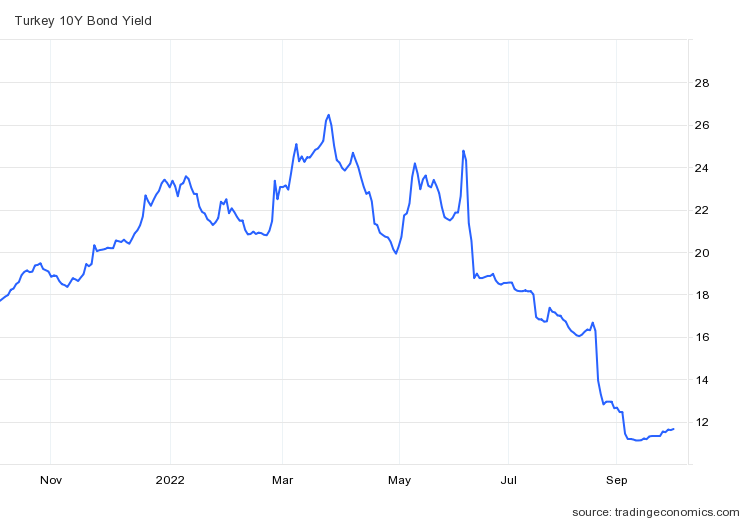
In June, Erdoğan made policy attempts to reduce Turkey’s stubbornly high bond yields, which had made borrowing costs extremely expensive for the government. Lenders in the nation were required to hold a certain amount of Turkish government bonds as collateral for its currency deposits. This led to a sharp fall in bond yields helping to reduce borrowing costs for the government but seriously exposed domestic banks to inflationary risk. The increase in demand for bonds was essentially driven by domestic compliance, not an uptake in foreign investment. In August, the central bank enacted new rules to try and reduce the interest rates offered to customers by domestic lenders. The higher the interest rate charged by the lender, the more Turkish government bonds the lender would have to hold, incurring more risk on the lender. This policy led to a further reduction in yields, with the 10-year yield falling to around 11%. The 10-year yield was above 20% prior to the original policy change in June.

Although inflation stands at over 80% year-on-year, the rate of growth of inflation has begun to cool, which has led to the Turkish government signalling that inflation will begin to decline. The reduction in inflation growth has been challenged by opposition parties and other economists, however. The reduction in inflation growth contradicts the data released by the Istanbul Chamber of Commerce (ICOC), an independent economic research group in Turkey. Although ICOC use a different methodology to calculate the inflation rate than TURKStat, the official statistics organisation in Turkey, their rate has closely tracked the official CPI rate over the last few years.

Erdoğan’s political influence on government agencies is extremely powerful in Turkey. He has sacked three central bank governors since 2019, a tendency that eliminates the political independence of Turkey’s central bank. In June of this year, Bloomberg reported that the Head of Consumer Pricing at Turkstat, Mustafa Teke, had stepped down from his role with no explanation as to why. This followed from the replacement of TURKStat’s president in January, whose tenure did not last a year. Statistical tampering by a government is not a novel situation. Greece falsified their GDP deficits in 2010 to calm bond markets prior to the European Debt crisis. Andreas Georgiou, the president of their statistical agency at the time, leaked the correct GDP forecasts to Eurostat in a rogue move that subsequently upset Greek authorities. In 2017, he was sentenced to two years in prison for a ‘breach of duty’ and remains in exile in the US today.

The Turkish general election is due to take place in May next year, which makes cooling rampant inflation a key objective for the incumbent Erdoğan to hold power. Although official figures show inflation beginning to cool, many investors may doubt the legitimacy of the figures and any major recovery in the Turkish economy in 2023. The various policies of Erdoğan have not managed economic success thus far but may remain, as the authoritarian leader’s AKP party remain ahead in opinion polls. It is hard to see where the light at the end of the tunnel is for one of the world’s largest emerging economies.

Recession Talk: The OECD Forecasts for the European Economy 

On Monday 26th September, the Organisation for Economic Cooperation and Development (OECD) released their forecasts for the global economy. The outlook is bleak. International output growth is projected to grow at a rate of 2.2% over 2023, down from initial projections of 2.8% growth for 2023. This contrasts negatively to a growth rate of 3% in 2022 and represents an even greater fall from 6% growth in 2021. The Russian invasion of Ukraine, the ongoing effects of China’s Zero Covid Policy, as well as an increase in interest rates by the ECB, Federal Reserve, and Bank of England, have been identified as the main causes of this sluggish economic activity. The OECD identifies the Russian invasion of Ukraine as a key contributor to these negative forecasts – with forecasts outlining a $2.8 trillion decrease in global GDP thanks to the invasion. It also notes that the economic impact of the War is greater than previous forecasts predicted.

As a result, ECB policy has transitioned away from negative interest rates. This tightening of monetary policy has led to a decrease in the money supply, alleviating pressure on prices. This has also been cited as a primary contributor for slower economic growth over the next calendar year. 

The OECD predicts that because the US Fed started contractionary monetary policy earlier, their high inflation levels will decline more swiftly than those of Europe and the UK.

The OECD also notes the impact of reduced energy supplies from Russia to the EU. Gas storage levels have recently been recorded at 90% of capacity in the EU. However, projections indicate that this initiative will not be sufficient on its own to assist households through the Winter. A serious reconsideration of energy usage in Europe is pivotal and new European policy must acknowledge the necessity of reducing gas consumption. The OECD projects that European growth could fall by a further 1.25% points relative to their initial forecasts for 2023 if supply is not better diversified and gas consumption reduced. This, together with increasing inflation, would plunge several European economies into recession in 2023 if European leaders do not properly confront the energy crisis.

Although slow and laborious growth is predicted for the Eurozone, a recession is unavoidable if gas consumption cannot be reduced or if problems arise with other energy suppliers to the European countries. The outlook for the UK looks even more bleak with the OECD projecting zero growth. Germany’s dependence on Russian energy supplies has seen the OECD project a contraction in its economy for 2023. The outlook looks bleak indeed.

Billionaire is ‘Going Purpose’ by Donating $3 Billion Company to the Earth

5 years after claiming that ‘We’re in business to save our home planet’, Patagonia founder Yvon Chouinard has followed through on his promise by donating his company to the earth. Chouinard founded Patagonia in 1973, and his values have always been central to the company. The company also donates 1% of its profits to charity each year and promotes an environmentally friendly business model, even going so far as to encourage customers not to buy Patagonia clothing new and instead reuse old ones.

In his open letter to stakeholders, it was clear that in selling the company Chouinard wanted to ensure both the financial success of the company and the charitable success of his donations. According to Chouinard, ‘there were no great options available to us, so we created our own.’

Chouinard decided to sell his businesses to two different entities. The first entity, the Patagonia Purpose Trust, received all off the voting stock which is equivalent to 2% of the company. The Chouinard family received nothing from this sale and paid $17.5 million in taxes.

However, by doing this Chouinard believes he and his family can ‘maintain our values’. The Patagonia Purpose Trust’s board will include the Chouinard family as well as directors equally committed to the success of the company and the planet.

As well as this, 100% of the non-voting shares will go to the Hold Fast Collective. These shares are equivalent to 98% of the company and will receive 100% of the profit. The Hold Fast Collective is a non-profit organization that advocates for clause and political candidates that fight for the environment. Patagonia expects to generate $100 million in profit to help the Hold Fast Collective.

Chouinard closed his statement with a message of hope: ‘Despite its immensity, Earths resources are not infinite, and it is clear we’ve exceeded its limits. But it’s also resilient. We can save our planet if we commit to it.’ Chouinard has set an example for all companies and governments, and one can only hope that his example is followed in time.

The Future of Digital Assets in the EU 

Many people have long seen the market for digital assets as the Wild West of investing, filled with lucrative volatility and a significant risk of fraud. However, the European Commission’s Markets in Crypto-Assets (MiCA) is a regulatory framework that seeks to change this. MiCA is due to come into effect in 2024 with the dual objectives of harmonisation of existing EU regulations and the protection of investors.

One of the key impacts of this new framework will be to broaden the scope of existing regulation to include additional Virtual asset service providers (VASPs). Owing to the market’s rapid development, many service providers are unregulated, putting investors at risk of exploitation. Crypto-asset service providers (CASPs) is a term that exists in many other jurisdictions and has now been adopted by MiCA’s drafters to replace the Financial Action Task Force’s well-known definition for VASPs. The CASP definition is very similar to the original definition however it is much broader in scope so as to provide for as many crypto-related entities as possible. The most important thing to understand is that all VASPs will be considered CASPs but not all CASPs will be VASPs as they will fall outside the previous, narrower definition.

VASP definition:

  1. Exchange between virtual assets and fiat currencies;
  2. Exchange between one or more forms of virtual assets;
  3. Transfer of virtual assets;
  4. Safekeeping and/or administration of virtual assets or instruments enabling control over virtual assets; and
  5. Participation in and provision of financial services related to an issuer’s offer and/or sale of a virtual asset.

CASP definition: 

  1. The custody and administration of crypto-assets on behalf of third parties; 
  2. The operation of a trading platform for crypto-assets; 
  3. The exchange of crypto-assets for fiat currency that is legal tender; 
  4. The exchange of crypto-assets for other crypto-assets; 
  5. The execution of orders for crypto-assets on behalf of third parties; 
  6. Placing of crypto-assets; 
  7. The reception and transmission of orders for crypto-assets on behalf of third parties;
  8. Providing advice on crypto-assets;

MiCA will also regulate the digital assets which currently fall outside the scope of EU and Member State regulations, such as e-money tokens, asset-referenced tokens and utility tokens. Surprisingly, MiCA does not address non-fungible tokens (NFTs), although the European Commission has indicated that it will address them in the future.

When MiCA comes into effect it will be applicable across the EU, without requiring Member States to introduce implementation laws. This uniform approach will bring about greater clarity and certainty for CASPs who are currently faced with differing domestic regulations across Member States. For example, MiCA will streamline the licensing process for crypto-asset issuers and make it valid across all Member States. 

Notwithstanding the greater ease of doing business, the regime itself will impose stricter obligations on CASPs so as to protect investors from market abuse and ensure transparency. These obligations relate to the authorisation of issuers and the marketing of crypto-assets themselves, as well as the requirement to publish reports and whitepapers. However, issuers that operate on a smaller scale will be exempt, such as those that deal with less than 120 investors per Member State. 

While some CASPs may be sceptical of MiCA’s impact on their business models, the Commission anticipates that the increased protection will attract investors. For example, CASPs involved in the custody of digital assets (custodians) will be required to store their customers’ assets separately to their own data, using Distributed Ledger Technology (DLT). This will ensure the assets are more secure in the event of a malware attack. Furthermore, these custodians will also be liable for losses that result from hacking or break down in technology. These requirements will undoubtedly increase consumer confidence and thus stimulate investment. 

Finally, it is interesting to note that because the safeguards relate to EU consumers, these changes will also apply to any firms outside the EU who wish to do business in the EU. Therefore, MiCA will have far-reaching implications for both CASPs and investors in the digital assets market not just in the EU but around the world. As Dublin is one of the world’s investment fund and asset management hubs it will be interesting to see what opportunities and challenges arise as a result of MiCA.

« Older Entries Recent Entries »