Category Archives: Finance & Economy

Good Morning Japan: BOJ Gearing up for Economic Change?

Kate Pusch

On Tuesday 31st October the Bank of Japan discarded a strict price ceiling on 10-year bond yields, one of the Bank’s monetary policies guarding against deflation. The policy change, a result of rising inflation, has instigated analyst discussion over whether or not the BOJ will finally tighten fiscal policy after nearly three decades of economic stagnation. 

Contextual Factors

In the wake of Japan’s economic bubble burst in the late 1980s, laxed monetary policy caused the Japanese Yen to dramatically decline against the US Dollar. If the Yen’s trade value (currently at 148.24) dips below 151.94, it will reach a 33-year low against the US dollar. While this has significantly increased export profits for many of Japan’s largest companies, executives have adopted an increasingly risk-averse attitude towards investing, causing  a large cash hoard to build up in Japan’s banks. Conversely, faced with higher import costs, corporations have been determined to keep other production costs down. Leniency with worker wage hikes, being one such example, has decreased Japanese purchasing power, driving down local demand and creating more stagnant economic conditions for smaller Japanese businesses to grow under.

Corporate reluctance to boost worker wages, despite mounting profits and the upward trend in inflation, presents a challenge for the BOJ who remains steadfast in its decision to withhold policy tightening measures until Japan achieves a stable 2% inflation rate. Although Japan’s inflation rate has surged notably in recent months, this is primarily due to external market shocks and the sustained devaluation of the Yen against the US Dollar. Meanwhile the absence of wage hikes has kept internal demand flat, if not on a decline. 

What Next?

As such, Japanese consumer demand is not the contributing factor to inflation the BOJ needs. The emergence of labour shortages resulting from Japan’s plateauing labour force, however, is putting pressure on companies to reconsider employee wages as an incentive strategy to attract and retain more employees. Such a change could kickstart a long-awaited price and wage growth cycle that would give the economy the boost it so desperately needs. 

More overall changes in policy will likely be indicated sooner by the BOJ’s updated inflation forecast – currently at 1.7% –that is to be published in January. Although it is unlikely the bank will follow up on its projections with action until April (when new wage negotiations are due to solidify), investors are still hopeful that it will indicate the BOJ’s direction for economic policy in the fiscal year 2024. 

Needless to say market watchers are holding their breath to see whether Japan seizes this chance to finally awaken from its long economic slumber.

Increasing Corporation Tax: A Glimpse into the Future of FDI in Ireland. 

Kitty Harburn

It is no secret that Ireland is an attractive tax refuge for multinational corporations. Since 2003, when the corporation tax rate was reduced from 40% to 12.5%, Ireland has seen a huge influx of foreign direct investment. Now the home to over 1,000 internationally recognised MNCs, a favourable corporation tax is one of, if not, the leading factor in Ireland’s corporate attractiveness. 

The Current Stage of Foreign Direct Investment in Ireland

ICTs (Information and communication technologies) are among the leading players in corporate tax revenue, with pharmaceuticals holding a top position in the last couple of years. In 2022, pharmaceutical companies and those in the chemical sector paid 46% more tax than those in the tech sector. Slightly more than three years after the onset of the COVID-19 pandemic, the income of pharmaceuticals has noticeably declined due to the diminishing sales of vaccines. Taking a closer look at  2022 tax receipts, it reveals however that 86.5% of the revenues stream came from foreign-owned MNEs. 

Following the release of the 2024 Budget, there is room for speculation about the future of Irish corporation tax revenues. International regulations set out by the OECD conclude that the minimum corporation tax rate will increase to 15%, from 12.5% currently, in line with the BEPS Pillar two. Following this policy release it is important to think about how might this increase in corporation tax affect the tax revenues obtained by the Irish government? Will MNCs continue to develop and expand in Ireland? With this change, it is important that Ireland stays attractive as a destination for FDI. Not only are there revenue advantages attached to these players in our market, but also socioeconomic benefits, including job creation.  

A quantified expectancy in tax receipts has not yet been speculated, however if Pillar 1 is implemented then the possible increase in net tax may be mitigated by this execution of legislation OECD proposal. 

Looking Ahead

Looking at Ireland’s position in 2023 in relation to corporation tax, Ireland has the third lowest rate in Europe. The increase to 15% will still leave the country in a favourable position, compared to the rest of Europe which has an overall average of 21.5%. However, Ireland relies on CT receipts a lot more than the OECD median, and in the last 10 years alone this reliance has almost doubled. Hence, any departure or decrease of the big players will have a significant effect on many areas, primarily tax budgeting and government expenditure financing. The “€2bn loss to be reached” speculated by officials is nonetheless a cause for concern in Ireland’s current economic environment. 

Although there is a loss of competitive advantage, overall the country still stands in a promising position for FDI and business growth. Aside from Ireland’s favourable tax system, other factors such as the evolved financial sector and skilled workforce are only a small few that make Ireland a desirable destination for business. Brexit has also seen an increase in the number of companies who have begun expansions to Ireland as a gateway to European operations, Stripe being one of the few. Ireland has EU member state benefits, while also being an English-speaking country, breaks down potential barriers and potentially offsetting a rise in corporation taxes. On top of this, Ireland has been ranked 1st In Europe for the ease of paying taxes per PWC’s paying taxes report 2020, highlighting the maintenance of the tax refuge status. 

Innovation has also been a key driver in the country in recent times, with tax policies introduced to support and promote this cause. Per the Budget 2024, the R&D (Research & Development) tax credit which will be increased from 25% to 30%, ensuring that Ireland stays attractive and competitive for FDI. Following reports from Silicon Republic who highlighted that “80% of companies in Ireland plan to increase R&D spending over the next 3 years”,  this tax legislation will ensure adequate benefits to companies who qualify for the credit and will be affected by the Pillar two that otherwise may have seen an increase in their net tax bill, easing concerns for the future of FDI.

Budget 2024: An Economic Analysis

Natalie Kollrack

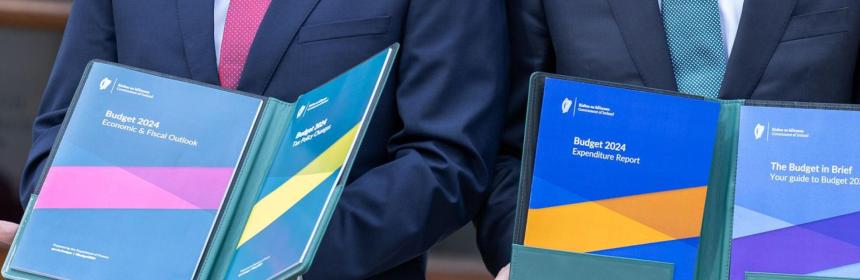
In speeches to Dáil Éireann last Tuesday, the 10th of October, Minister of Finance Michael McGrath of Fianna Fáil, and Minister of Public Expenditure, NDP Delivery, and Reform Paschal Donohoe of Fine Gael unveiled the 2024 Budget. Key themes in this year’s budget included supporting Ireland’s current society and augmenting sustainability, while also considering future implications of increasing public expenditure. The total budget package was to the tune of €14 billion, funded in part by €250 million from windfall corporation tax receipts. Interestingly, the government, boasting a budget surplus of €8.8 billion, would have encountered a €2 billion deficit were it not for the windfall corporate tax receipts. This article provides an overview of the primary provisions and delves into the criticisms raised by economists regarding its potential ramifications.

Housing

Minister McGrath detailed efforts from the government regarding housing – a prevalent issue in contemporary discourse. McGrath announced that homeowners with an outstanding mortgage balance from €80,000 to €500,000 on their house will receive a one-year Mortgage Interest Tax Relief. This will cost about €125 million and will benefit about 165,000 mortgage holders. The Rent Tax Credit has been increased from €500 per year to €750 per year, a temporary tax relief to keep small landlords from leaving the market. Additionally, the Help-To-Buy Scheme, the Vacant Homes Tax, and the Residential Zoned Land Tax are all intended to be extended. Lastly, Minister Donohoe reported that there are plans for 29,000 homes to be constructed by the year’s end, with 21,000 already built.

Finances

Minister McGrath celebrated falling inflation, with an estimated rate of 5.25% for September this year, and predicted a 2.9% inflation rate for 2024. In response to inflationary challenges, McGrath and the Department of Finance have escalated public spending from 5% to 6.1%, even as they anticipate income growth outpacing inflation due to a thriving economy. Their plan is to revert it to 5% as inflation diminishes.

Additionally, the government has also increased personal income tax to support workers and achieve efficiency in the labour market: the cutoff point for the lower income tax bracket has been raised by €2,000 for both single and married individuals. On the wage front, the national minimum wage has been increased by €1.40 to €12.70 per hour.  The Universal Social Charge, or USC, has been decreased for the first time in five years, from 4.5 to 4%, and the threshold for USC will be raised to €25,760. Finally, the government has introduced the Future Ireland Fund, made to support future government expenditure, which will receive a 0.8% investment of GDP annually.

Education & Health

Minister Donohoe has allocated a significant proportion of the budget to the Department of Education. Regarding higher education, he announced a once-off reduction of €1,000 for students qualifying for free fees, as well as payments to help students with secondary education. For the health sector, Minister Donohoe announced additional recruitment to increase healthcare staff, as well as continued investment in public health and vaccinations. To combat smoking, Minister McGrath announced an increased excise duty on tobacco products, raising the price of cigarettes to €16.75, additionally proposing a domestic tax on E-Cigarettes in next year’s budget.

Climate

Minister McGrath has taken steps to address climate change concerns by launching the Infrastructure, Climate, and Nature Fund, which is set to increase to €14 billion by 2030. The fund’s financing includes an annual contribution of €2 million and a share of the windfall from corporate tax receipts. On the public transportation front, Minister Donohoe has introduced funding for cycling, walking, and Greenways infrastructure, with additional fee reductions being introduced to encourage the usage of public transportation. Regarding energy, Minister Donohoe mentioned a target of 80% of electricity coming from renewable electricity in 2030, as households prepare for the cold winter ahead. Additional funding to increase environmental sustainability and to support farmers was also cited. Last but not least, Donohoe announced that approximately half of the income from carbon tax revenues will be reinvested to enhance energy efficiency in homes.

Other

Less prominent but nonetheless important, in the digital sector Minister Donohoe announced funding in the National Broadband scheme, extension of broadband to rural communities, and investment in cybersecurity. Funds have been allocated to the tourism sector, creative arts sector, the Gaeltacht, and sporting infrastructure as well. Support for the justice sector involves investment in Gardaí recruitment, an increase in the Gardaí budget, and investment in the defense sector. Funds have been allocated for foreign aid to developing countries, especially for those struggling with the impact of climate change. Finally, investment has been announced in peace-promoting and other cross-border projects with Northern Ireland.

Reception from Economists

Measures on housing have been met with heavy criticism from economists. David McWilliams, Irish economist and writer, argues these measures have done nothing to make housing more affordable and available. Instead, these measures are contradictory and only help existing homeowners, not first-time renters and buyers. In theory, the rising interest rates Ireland is currently experiencing should increase the cost of borrowing, thus decreasing the amount of money people can borrow, decreasing the size of new mortgages on houses for sale, and decreasing housing prices. Therefore, the government need not introduce any other measures as prices will fall on their own. The tax relief given to mortgage holders simply increases housing prices – the exact opposite of what the government claims to be doing. If the government continues to give a once-off relief every time interest rates increase, housing prices may  continue to increase as well. McWilliams believes the government has not built enough homes, considering net migration to Ireland significantly exceeds predicted levels. He argues that the rental tax credit and the Help to Buy Scheme could have a contradictory effect of putting upward pressure on rents. In final remarks, McWilliams emphasizes the potential drawback of tax credits designed to keep landlords in the market, potentially exceeding a cost of €100 million, especially if they had no intention to exit.

Dr. Barra Roantree, Economics professor at Trinity College Dublin, joins McWilliams in arguing the Help to Buy scheme should not have been extended  as it has demonstrated a propensity to inflate housing prices. While the Mortgage Interest Tax Relief scheme could be helpful to those suffering to pay loans from non-bank lenders hiking interest rates, overall, this policy is mainly helping people who do not need the relief. Additionally, Dr. Roantree notes concerning similarities between this relief scheme and a scheme that caused the Financial Crisis of 2008. Leading up to the financial crisis, people were receiving mortgages higher than they could afford, increasing property prices. When too many mortgages were given to people who normally would not qualify, a housing bubble was created – and every bubble inevitably bursts. Finally, Dr. Roantree criticized the Rental Tax Credit, arguing there is no evidence to show the tax relief is keeping landlords who would have otherwise left. He postulates landlords are not leaving the market due to tax but due to retirement, as many became landlords in the Celtic Tiger era. Thus, a tax relief would not have an impact on their decision.

The Irish Fiscal Council, a watchdog on the government’s procedures, has also given an opinion on the budget. The Fiscal Council approved of the new Future Ireland fund, as it argues it could unburden future taxpayers. However, the council had a host of critics regarding other measures. It is concerned about the increase in core net spending to 5.7% in 2024, which breaks the National Spending Rule of 5%, and argues the predicted break of the Rule to 2026 undermines Ireland’s public finances. The Fiscal Council criticizes the Irish government’s current adherence to procyclical fiscal policy (involving the augmentation of government spending and the reduction of taxation during periods of economic growth and low unemployment) as it has been damaging to Ireland in the past. Additionally, it predicts the larger permanent budget package will increase inflation and keep it at high levels for a longer period. Considering the robust economy, declining prices, and inflation risks, the Fiscal Council discerns minimal rationale for additional ‘one-time’ or transient policies. It specifically points to non-core funding, which was created for exceptional circumstances like Covid-19 and the humanitarian response to the war in Ukraine.

Members of rival political parties were also among the prominent critics of the 2024 Budget. Sinn Féin TD Pearse Doherty declared it a “budget for landlords.” Similarly, Holly Cairns, leader of the Social Democrats, argues the budget supports landlords more than it does tenants or first-time buyers.

Irish Congress of Trade Unions (ICTU) Secretary Owen Reidy argues the tax relief for landlords has made the taxation system more regressive, as opposed to progressive (like the USC). Reidy echoes members of the public arguing that the government has not gone far enough: the minimum wage should have been raised higher, higher education fees should have been decreased further, and more should be done to address the housing crisis and cost of living. There is also general criticism of too many temporary measures, especially the large number of “once-off” taxes. Patrick Leahy of the Irish Times argues that “once-off” taxes have been used so frequently that the phrase has lost its meaning.  Furthermore, he underscores the worrisome failure to address the housing crisis, especially since a significant number of young voters view housing as their primary concern. Finally, there is a prevalent argument that the budget predominantly caters to the middle class – which should not be surprising as Fine Gael prides itself as the party of the “squeezed middle”.


Influential Women in Finance

Following on from the last article about growth vs value as two investing strategies, here are lessons that beginner investors can take from some of the most well-known women in the investment world on how they invest their money and their best pieces of advice. One such example is Cathie Wood, CEO of Ark Investment Management. Wood studied Economics and Finance at the University of Southern California and then began managing money all the way from analyst to portfolio manager to CIO.

Her company launched its own ETF, characterised by its non-specific sector allocation to try to capitalise on a broad range of markets. Moreover, the ETF mainly focused on disruptive technology companies, who use existing successful technologies and innovate by improving them or replacing them with better, cheaper or faster products. Wood, as an active investor, looks for companies with huge growth potential, purchasing young Tesla as a hallmark investment.

However, last year was not the most successful year for Cathie Wood and Ark Invest. Many of its holdings steeply declined and the fund lost customers as a result; this tested the strength of Wood’s active investment strategy. Wood made new investments during the tech sell off despite criticism.

A second fascinating woman in finance is Mary Callahan Erdoes, CEO of JP Morgan Asset & Wealth Management since 2009. Her work primarily involves retaining and growing clients’ assets. As a result, she has increased client assets at JP Morgan Asset & Wealth Management to over $4T.

Her advice, as she said in an interview with David Rubenstein, is that first of all you should not invest into something which cannot be explained to you in simple terms. You should also start saving early to have an impact, because only over long periods of time does investing become very successful with less risk. When it comes to risk management, people should never excessively risk the money they have worked hard for. This stress test can be carried out as a measure of portfolio diversification. If one position heavily declines in the worst case scenario, the rest of the portfolio holdings should be able to salvage a bad investment.

In finance, networking, lobbying and the influence of office politics make people like Erdoes or Wood very successful. This is not easily applicable to the average retail investor, but it is important to mention to understand top investors’ success stories. Specifically, networking is key because of the private information which might not be as available to the public. Lobbying and politics are two factors that you can only predict and incorporate into your investment strategy if you have the relevant information as an established institutional investor.

An obvious, but often easily forgotten factor that should not be overlooked is the actual product(s) the company offers, not just the company and its potentially good management. Taking a closer look at the products a company offers, as well as the product life cycle is vital. This cycle shows the development from its introduction to the withdrawal of the product from the market. The four stages are introduction, growth, maturity, and decline. If a company’s product is relatively well established and has had huge success, it is now in the maturity stage and the market might soon become saturated. If the company does not innovate a new product or add-ons, its sales will drop thus hurting earnings. Hence, this might not be the best investment.

These pieces of advice from some of the most renowned investors are invaluable as their experiences help smaller retail investors, like us, find the right investments and avoid the wrong ones. Echoing one final piece of advice from Mary Callahan Erdoes, “if something is too good to be true, there’s a high likelihood that it is”.

Value and Growth Investing Methods

For many people who start investing, it is difficult to figure out the most important criteria in making their investment decision. In addition to knowing basic investing vocabulary, it is also helpful to understand some of the basic investing methods. Star investors like Warren Buffett and Cathie Wood are famous today for their value and growth approaches to investing, respectively.

Warren Buffett is one of the most famous investors worldwide and is known for his strategy of value investing. Buffett is the CEO of Berkshire Hathaway and has more than half a century of experience. His net worth now amounts to over $115.5 billion. One of his secrets to success is that he started investing when he was unimaginable eleven years old. However, that is not realistic for most people to achieve since interest in finance often develops at a later stage. That being said, the lesson to be learned is that there is no time to lose when it comes to starting to invest. Success most likely comes in the long run. Buffett’s success also lays in his acquisition of 60 companies which now account for Berkshire Hathaway. Buffett first contact with value investing was through his former mentor Benjamin Graham at Columbia Business School. He first applied and defined this strategy.


The core idea behind value investing is to first determine the intrinsic value of a company and then compare the value of the company to the current stock market price. When also comparing the stock price to that companies’ competitors, one can see if the stock is underpriced. Then, a decision can be made as to whether a company is worth investing in.

When looking at a company from a value investing point of view, one must first look at the management and fundamental quality of a company before looking at the price. One should be able to see whether the company has a leading, experienced team, and if they have a track record of overcoming challenges. A long term strategy is key with this investment method since one must believe the quality of the business behind the stock will push up the price; short-term price falls mean value investors can buy the same business at a cheaper price.

Growth investing, meanwhile, is all about a fast approach to get to the desired price target. Obviously, like the name already predicates, the most important criterium is fast growth in comparison to the market, apparent through higher than average returns. Companies which show these characteristics are often younger firms in futuristic markets, such as electric vehicles. Because growth companies tend to be younger, investors often do not get dividends when investing in companies like this; rather, the company’s profit is used to reinvest back into the company.

Each of these investment methods offer a different way to view a business and its investment decisions. One can look for stocks selling at discounts based on a fundamental analysis, or one can look for a stock that is poised for rapid price growth. These strategies are often used by successful investors in the financial world, especially women like Cathie Wood. Stay tuned for the next finance article that will delve into inspiring women in the world of finance.

« Older Entries Recent Entries »