Author Archives: TBR Team

Interview with Deirdre McIlvenna – Partner at the Maples Group

Introduction

Over the past five decades, the Maples Group has become a global market leader in the provision of corporate legal services. The Group has 16 offices across the globe with operations in Europe, Asia Pacific, and the Middle East, as well as the Americas and Caribbean. Launched in 2006, the Irish office has become one of the largest in the Maples network. Speaking with funds and investment management partner, Deirdre McIlvenna, the Trinity Business Review team learn about a career in corporate law, the funds industry in Ireland, and Maples’ Professional Internship Programme.

The Maples Group  

With over 440 professionals in its Irish office, the Maples Group has a wide range of practice areas, including Corporate, Data, Commercial and Technology; Employment; Finance; Financial Services Regulatory; Funds and Investment Management; as well as Litigation; Property; Projects and Infrastructure and Tax. The wide range of services enables the firm to tailor its offering to the unique requirements of its clients. However, the focus of the firm is directed at funds and investment management, as well as finance and corporate, reflecting the strength of the Irish financial market. Deirdre notes that the firm is increasingly advising on sustainable finance and renewable investment projects within each of these core practice areas.

The Maples Group also prides itself at being at the forefront of innovation in legal service delivery for its clients. Deirdre recognises that ‘delivering legal services efficiently is a critical priority’ in an ever-changing technological landscape. By leveraging a wide range of innovative legal technology tools and techniques across its practice areas, Maples can deliver its services in a cost-effective and productive manner, ensuring greater value for its clients.

Deirdre is of the view that the unique selling point of the Maples Group is that it is a ‘genuine international business’, serving numerous international clients. This global reach brings crucial perspective and comprehensive expertise to the firm. Maples strives to provide time-zone convenient legal advice and ancillary services in regions where their clients are based. The firm also takes pride in a partner-driven knowledge culture, investing significantly in keeping up to date with all Irish, EU and International market developments which impact on its clients. This requires extensive planning as well as communication with relevant government departments, regulators, and industry associations on proposed legislation. Deirdre notes that ‘commercial awareness is very important’ and, according to its clients, this sets the Maples Group apart from other law firms. The firm places a huge amount of value in knowledge sharing, which is achieved through ‘Know How’ meetings and the support of the Professional Support Lawyer (PSL) team.

The Irish Funds Industry  

Ireland’s fund industry was established over three decades ago and has continued to grow, with net assets in Irish domiciled funds rising to €3.32 trillion in 2020. Investment managers and asset managers from all over the globe have sought to develop and expand their European distribution footprint through Ireland, motivated by our globally recognised skilled workforce and our ability to provide full access to the EU. As a result, the Irish office serves as an important European hub for internal clients doing business in and from Ireland.

This growth in the Irish funds industry has contributed significantly to the growth and development of the Irish economy. Deirdre comments that it has been ‘hugely rewarding’ to be part of this success. The Maples Group maintains strong connections and representations on various working groups, including Irish Funds, AIMA, and the American Chamber of Commerce. The firm is also in direct communication with the Central Bank of Ireland, being the governing body for Irish regulated funds, as well as the Department of Finance, on projects such as the Sustainable Finance roadmap.  

Deirdre observes that ‘no day is ever the same’ working in the Irish funds industry. In Ireland, each regulated fund is required to appoint regulated service providers, such as fund administrators and investment managers. In her role of legal adviser, Deirdre is in contact with these various service providers, as well as with auditors and tax professionals. This interaction with different people from diverse areas is something which Deirdre has ‘really enjoyed’ during her career. She says that ‘there is always something new and interesting taking place’ each day.’ 

Professional Internship Programme

Maples Professional Internship Programme is the firm’s ‘primary recruitment method for future trainees’ and provides ‘an excellent platform for those interested in securing a training contract’ with the firm. Last June, the Maples Group welcomed 29 students into its Irish office and looks forward to seeing many of these interns return to the firm as trainees in future years.

The Programme has been thoughtfully structured to ensure that interns gain an invaluable insight into life as a corporate lawyer at the firm. It includes a mix of training; department, committee, and global talks; various workshops, Q&A sessions, and several social activities, ensuring interns are exposed to a range of diverse and interesting work. Interns are offered the opportunity to work alongside Partners, Associates and Trainees in one of the firm’s core practice areas, namely, Corporate, Employment, Finance, Funds & Investment Management, Litigation, Property and Tax, and are paid for the duration of the placement. Deirdre is of the view that ‘people are our greatest asset’ and as such, ‘recruitment and retention of talent is a core part of our business strategy’. A law degree is not a precursor to applying to the Maples Group and Deirdre observes that some of the firm’s best lawyers have undertaken different courses. The firm looks for applicants who are good team players with strong communication skills and ‘a curious mind’. 

Further Information

Applications for the Maples Group’s Professional Internship Programme close midnight 7 February 2022.

Website: https://maples.com/en/careers/students-and-graduates/internships

Big Tech: The Precarious Balance Between Algorithmic Governance and Democratic Accountability

by Rachel Carr

Over the past months Amazon and Alphabet have reported phenomenal earnings for the second quarter of 2021. These figures were largely driven by Google skyrocketing advertising revenues, which grew by 69%, along with Amazon’s advertising income which increased by 87% from the year ago quarter. These results reflect the central role that social media and technology have played in society over the last year, not only in offering a much-needed escape from the boredom of COVID-19 lockdowns but also in their newfound role as public forums. Last April, when the Italian Prime Minister decided to address the nation on the latest lockdown measures, he elected Facebook as his chosen medium of communication. Similarly, the British government requested Amazon’s assistance in distributing emergency medical supplies and Google leaped at the chance to assume its role as a mouthpiece for public services announcement across the globe. 

However, as the “Gordian Knot” that entangles Big Tech with its societal consequences tightens further, we should consider the motivations behind the growing presence of these tech heavyweights in our lives. What exactly are these  tech giants selling to their customers and what are the potential consequences?

To understand what triggered the phenomenal rise of Big Tech superpowers we must first cast an eye back to April 2000, when eager dot com investors watched in horror as the stock market imploded and the value of their portfolios plummeted. As the mirage of many of Silicon Valley’s superstar valuations began to evaporate, it became clear that in a text-book case of irrational exuberance, venture capitalists had been so blinded by the lure of the internet’s potential, that they had wildly overestimated the intrinsic value of their investments. 

Surviving tech firms, struggling to justify their value to furious investors, began to search desperately  for a port in the storm as the turmoil raged. Amongst them was Google, today’s search-engine giant,  which had been incorporated a mere two years prior. According to Shashona Zuboff, the Harvard Business School professor and author of ‘The Age of Surveillance Capitalism,’ the dot com bubble triggered Google’s understanding that its true value lay not in the licensing deals it had been selling, but rather in its vast stores of behaviourally rich data. Despite the company’s founders previously condemning search engine advertising as “inherently biased towards the advertisers and away from the needs of consumers”, the firm went on the capitalize on just that, with Facebook, Amazon and Twitter soon following suit.

Zuboff has coined this commoditization of the data of individuals into behavioural products that can be sold in ‘predictive futures markets’, as surveillance capitalism. In recent years the cautionary tale of “if you aren’t paying for a product you likely are the product” has been widely circulated. Of this the general public seems to be reasonably cognizant: an hour spent on Skyscanner will likely flood your feed with holiday advertisements and a trip to the ASOS homepage will litter your desktop’s ad space with outfit ideas. However, it was what the “FAANGS” discovered next, and the lucrative source of the last decade’s soaring tech valuations, that is likely to induce the most surprise. Google and its peers deduced that while it could use its data to predict the future behaviour of users with reasonable accuracy, the easiest way to guarantee the precision, and thus value of those predictions, was to influence the behaviour of users to match the algorithm’s forecasts.

An example of the application of this insight was the addition of a number of emotional reactions to Facebook’s ‘like’ button. While this modification poses as a harmless quirk designed  to allow users to further engage with the platform’s content, it also assists Facebook’s algorithms in accurately identifying and collating data on human emotions. The opportunities resulting from the utilization of this data are massive. Users can be shown posts designed to induce feelings of discomfort or sadness, followed by sponsored content intended to take advantage of this vulnerability. Along a similar vein, Google has been known to display ads for a specific restaurant and then reroute a user’s map  journey to take them past the suggested establishment: a perfect example of the use of surveillance  and behavioural modification to maximise profits at the expense of individual autonomy.

The implications of these privacy infringements extend beyond the encouragement of the occasional impulse purchase. In 2017 the autonomous hoover ‘Roomba’ came under fire when the company announced its proposal to sell floor plans of customers’ homes, scraped from the device’s mapping capabilities. Later that same year the curtain fell on the infamous Cambridge Analytica scandal, revealing the role the data analytic firm had played in manipulating the data of 87 million Facebook users to manipulate the outcomes of both Trump’s 2016 Presidential the Brexit vote. This proof of intentional cyber manipulation, designed to promote the so-called ‘splinternet’, revealed the power of Big Tech behavioural nudging to distort democratic processes. In fact, in 2019 Mark Zuckerberg’s former advisor Roger McNamee publicly criticized Facebook for its relentless pursuit of  customer data through increasingly illicit means claiming that the company’s algorithms were, ‘’honed to manipulate user engagement with practices that were eventually commandeered by bad actors to infiltrate the national (US) consciousness and disfigure political discourse.” Earlier this year Zaboff subtitled her New York Times article with the ominous statement, “We can have democracy, or we can have a surveillance society, but we can’t have both.”

Whilst the extent of the influence of Big Tech on the democratic process is yet to be determined, it is undeniable that  tech companies have amassed vast stores of behavioural data which can spell danger in the wrong hands. As a result, there is an argument for putting certain social obligations on companies with such data privileges; in other words, “With great power comes great responsibility” . Covid-19 revealed Big Tech for what it truly is: a 21st century public forum. Due to their wide-reaching social impacts, large technology companies should be answerable to the governance of regulatory bodies. If banks, electricity, water and utilities companies are regulated because of the impact of these services on a nation’s citizens, then there is reason for Big Tech to no longer be able to evade such scrutiny.

Learning Lights: A Candle-Making Start-Up With A Twist

A candle-making start-up with a twist. This plucky young start-up was founded with the aim of helping students from low-income backgrounds afford third-level education. The business model is simple. The start-up manufactures and sells a range of scented candles and then invests the majority of the business’s profits into an endowment fund. The endowment fund, which will be managed by a third-party investment manager, follows a dedication strategy, investing primarily in high-grade investment bonds. Jody, the company’s founder believes that “the benefit of investing in an endowment fund instead of distributing the profits directly to qualifying students is that it gives greater stability. If the profits were to be distributed directly, the distributable amount would fluctuate greatly with yearly sales. By investing in an endowment fund this volatility can be reduced”.

The Founder

Learning Lights was founded by Jody Murphy, a third-year business student who is heavily involved in societal life at Trinity. He believes that the private sector could do more to improve equality of opportunity particularly with regards to the financial accessibility of third-level education, and so he decided to take action.

The Candles

Learning lights not only helps students, it also helps the environment, through its sustainability agenda. All candles are made from natural soy wax and are set in recycled glass bottles. In addition to this, all the  candles are handmade and dispatched within 2 days of purchase. Currently, there are five scents (Vanilla, Rose, Sandalwood-Vanilla, Lavender, and Japanese Magnolia)  available in two sizes (13.5 oz, and 8.5 oz).

Plans for the Future

Within the first 24 hours of trading, Learning Lights had sold all of its inventory. It was anticipated that there would be a slump in sales after the initial launch, however, the revenue from the launch has brought cash into the business that has allowed Learning Lights to continue to improve its online presence as well as fund more inventory. Within the next week, Learning Lights will become available in several locations throughout Monaghan and Dublin.

“Thankfully, there haven’t been any major issues so far, just some minor start-up hiccups,’ says Jody.

In the coming months, the Learning Lights Alliance Initiative will come into action. This involves businesses that burn candles on their premises, such as salons, cafés, restaurants and hotels, becoming Learning Lights Allies by purchasing and burning Learning Lights.

Trinity Society Involvement

Jody credits the business societies at Trinity for helping him take the first steps in launching this venture. In his second year at Trinity, he became an ambassador for the TES incubator programme. By engaging in this programme, he not only learned a great deal about developing a start-up, but also gained valuable exposure to start-ups that were involved in the incubator programme.

Jody is also part of the Trinity Business Review team and is currently the Secretary and Chief Strategy Officer. In this role, Jody has gained confidence and gained significant knowledge of the Irish business environment.

Check Learning Lights out at

Etsy: LearningLights on Etsy

Shop in Ireland: Shop in Ireland | Gifts for all occasions | Irish handmade |

Instagram: Learning Lights (@learninglights_candles)

How COVID-19 is Impacting Gender Inequality

BY Gaia Aviloff

COVID-19 has exacerbated gender inequality in the job market. Recent studies have shown that the global pandemic is disproportionately affecting women in two main ways. Firstly, women work in the hardest-hit sectors. Secondly, the closure of schools and the shift to online learning have impacted women’s ability to work from home. 

The study The Labour Market Impacts of the COVID‑19: A Global Perspective shows how 40% of all employed women work in the sectors that have been most affected by COVID-19.  The UN WOMEN has released data revealing how female unemployment fell by 50% in Asia and the Pacific compared to 35% in male unemployment. To help evaluate which sectors have been most affected, the study The Impact of COVID-19 on Gender Inequality has distinguished two criteria:

  1. Whether or not current regulations have limited the sector’s output
  2. Whether or not the sector allows for telecommuting

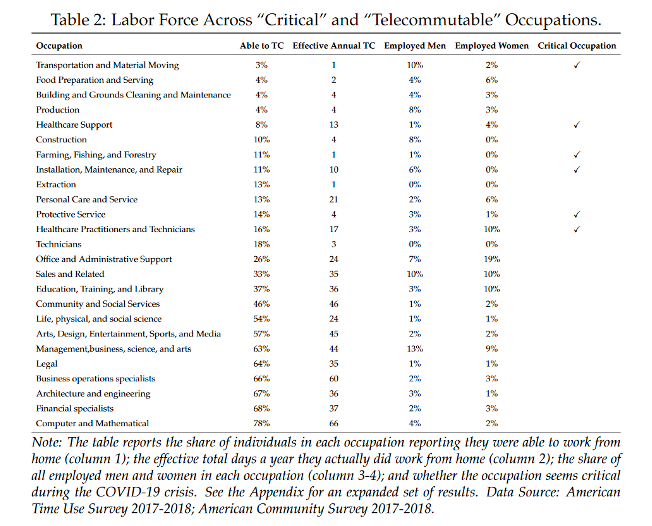
The sectors considered ‘essential’ are Transportation and Material Moving; Healthcare Support; Farming, Fishing, and Forestry; Installation, Maintenance, and Repair; Protective services; Healthcare Practitioners and Technicians. Women work in 4 out of these six sectors, and men work in 6 out of the six sectors. Moreover, 70% of women who work in healthcare services, social work, or who are frontline workers are paid less than their male counterparts.

On average, in the United States, 28% of men work in sectors that allow for telecommute compared to 22% of women. Thus, women will be more likely to face unemployment as they work in industries that cannot adapt to the new remote working format. The graph below shows which sectors are considered essential and which allow for telecommuting in the United States.

 In households where both married members can telecommute for work, the wife will most likely quit her job to provide childcare and housework. In Europe, the pandemic has exacerbated these gendered patterns, with women reducing their work hours 4 to 5 times more than men.

The closure of schools, childcare services, and day centres coupled with older relatives’ unavailability has further splintered gender inequality. There has been an increase in childcare needs with children staying at home and having classes online. The distribution of childcare needs varies on the work arrangements of the members within a household. In the United States, 25% of married couples have a traditional labour division in which men are employed full time and women stay at home. However, in only 5% of married couples, the arrangement is the opposite. In marriages with traditional work distribution, the increase in childcare needs will fall on women. The European Institute for Gender Inequality shows how, before COVID-19, married women provided 39 hours of childcare and married men provided 21 hours. The rise in childcare needs has further amplified the gendered patterns in the unequal distribution of childcare. The graph below illustrates the division of childcare and housework in households across 22 countries.

                                   Source: UN WOMEN

The division of childcare within a family reflects the existing disparities between men and women.

Single mothers are the most vulnerable to these changes. They must juggle home-schooling, the rise of childcare needs, and work. Single mothers must also rely on a single income; however, studies have shown that they are more likely to work in sectors that have been most affected by current restrictions. According to the Central Statistics Office, there are 44.5% single mother households in Ireland compared to only 18.6% single fathers. Single mother households are more at risk of living in poverty since most governments worldwide do not supply social coverage.

Nonetheless, the study The Impact of COVID-19 on Gender Inequality proposes that the flexible working format may produce greater gender equality. The conversion to remote working, adopted during the pandemic, is likely to persist in a hybrid form. More fathers will be able to participate in childcare needs and housework actively. Which can lead to an equal distribution of household tasks as both members may balance their careers with childcare needs and housework. Studies have shown that boys with a working mother will be more likely to marry a working woman contributing to changing gendered norms.

The European Institute for Gender Inequality suggests that the EU promotes education free from gendered stereotypes. Women may access less impacted sectors which allow for telecommuting. The study also states how: “Addressing women’s under-representation in STEM occupations could create up to 1.2 million jobs and increase GDP by up to EUR 820 billion by 2050.” By implementing policies that aim to reduce gender inequality in the labour market, EU member states will see higher economic growth and greater financial stability.

Goodbye 9-to-5, Salesforce to offer flexible work schedules to employees

By Matthew Quick

“The 9-to-5 workday is dead.”

Coronavirus has drastically changed the way business is handled since it first began over a year ago, including the way we work.

Last Tuesday, Salesforce announced that the company will no longer expect their employees to follow the 9-to-5 work schedule that has defined the modern workplace. Instead, Salesforce will be introducing a new system in which employees can choose a more flexible working schedule that determines how often they come into the Salesforce offices.

The company has offered three separate options to employees. A flex option will see employees returning to the office one to three days a week, once it is deemed safe to do so. The company states that most Salesforce employees will work via these conditions, as 80% of those surveyed still seek a physical connection to the workplace. A fully remote and a more traditional office-based option will also be offered based upon the employee’s needs.

The changes come after the company surveyed its employees at the start of the pandemic. “We learned that nearly half of our employees want to come in only a few times per month, but also that 80% of employees want to maintain a connection to a physical space,” Brent Hyder, President of Salesforce, wrote in a blog post announcing the changes.

Hyder also wrote that offering a more flexible work schedule is aimed at increasing productivity and creating greater equality in both terms of hiring and work-life balance. “In our always-on, always-connected world, it no longer makes sense to expect employees to work an eight-hour shift and do their jobs successfully,” Hyder wrote. “Whether you have a global team to manage across time zones, a project-based role that is busier or slower depending on the season, or simply have to balance personal and professional obligations throughout the day, workers need flexibility to be successful.”

Salesforce is among a growing list of tech giants allowing their employees to have more freedom over their work schedules. Last October, tech giant Microsoft announced that the company would be embracing a more flexible workplace that would allow some employees to work from home even after coronavirus restrictions are lifted. Salesforce is also looking to update its office spaces once employees return to work. Diverting from a more traditional workplace, “community hubs” will replace desks with breakout spaces meant to foster human interaction.

Salesforce employees began working from home in early 2020 and are expected to continue working from home until at least July 31, 2021, the company stated. The latest changes being made by Salesforce and fellow tech companies indicate an evolution brought on by coronavirus. Companies and employees alike have developed different expectations from one another as a majority of the global workforce works from home.

“This isn’t just the future of work, this is the next evolution of our culture. We’re combining the strength of our values, our platform and our people to reimagine the way we work for the better — whether in-person or in the cloud,” Hyder wrote.

« Older Entries Recent Entries »