Category Archives: Deep Dive

Creative Destruction: Gaining in strength?

Perhaps one of Schumpeter’s most revered theories is that of creative destruction. His argument that capitalism never stands still, with long-standing, inefficient processes decaying in the wake of newer, superior ones has stood the test of time well, and in the aftermath of a global pandemic, appears to continue in this light.

WFH – a trend, an improvement, or both? 

A more obvious impact of the pandemic-induced lockdowns was the ‘Work From Home (WFH)’ situation, which many workers and students found themselves in. While evidence suggests that students and young graduates certainly wish for a return to an in-person normality, the technology, flexibility and heightened global interconnection that accompanied this WFH trend can be seen as a form of creative destruction. This is due to the replacement of older, less efficient, less flexible practices undertaken by offices with more productive, collaborative ones. With meeting participation increasing by over 2900% over the course of the Pandemic, the rise of Zoom neatly epitomises this creative destruction. Existing for almost a decade prior to the pandemic, Zoom’s overtaking of Skype, and other lower quality, more complicated platforms, coupled with a rise in global interconnectivity from which it prospered, illustrates that the foundations for creative destruction had been in place. However, it was the catalyst of the Pandemic that fuelled the eventual ousting of these inefficient processes.

Miracle Advances in Healthcare

Being a crisis in healthcare, the impacts of Covid-19 on the sector were always going to be large. As the world locked down, the personal profit from vaccines became huge, with many viewing vaccine development as the only sustainable way out of the crisis. Furthermore, for big pharma businesses, net profits from development were promising, as BioNtech’s expected revenues of €15.9 billion for this year illustrate. Thus, the fastest vaccine development in history (previously held by the mumps vaccine, which took four years to develop) followed, hailing what scientists proclaim as a new era of vaccine research. Much like the Work from Home technology, the knowledge of mRNA, alongside the ability to accelerate the testing and approval processes had been around for decades, yet a lack of funding and cooperation meant that such techniques and pace never came to fruition. Thus, the catalyst of a global pandemic rendered inefficient processes useless, in favour of more productive research techniques. While admittedly this research was far better funded than in the past, the lessons learned within the immunisation research sector, alongside the new-found ability to produce vaccines at such pace, and with new techniques, means that the creative destruction ought to last within the industry. This should heighten the efficiency and productivity of future research.

Similarly, the speed of drug development processes to aid those seriously ill with Covid-19 underwent rapid increases during the pandemic. Like with the vaccines, much of this came from the regulation-side, with approval and testing processes being fast-tracked, and the removal of unnecessary paperwork (recognised as inefficiency-inducing ‘sludge’) aiding this. Additionally, cooperation and parallel experimentation again played its part in heightening efficiency in the sector, a rise in productive techniques that many scientific researchers think will remain in a post-Covid world, further illustrating the impact of the pandemic on inducing creative destruction.

Online Shopping’s Anticipated Breakthrough

Where the biggest acceleration (rather than initiation) of creative destruction can be seen is in the retail sector, as many began relying solely on online shopping for everything from food to clothes to newspapers. Additionally, HSBC’s UK head of network noted that the closure of eighty-two of their branches between April and September 2021 was a result of the trends away from branch banking that were underlying pre-Coronavirus, with a decrease in footfall by a third in the last five years, and 90% of contact being completed remotely. This illustrates direct creative destruction at work in the retail banking sector. Furthermore, this shift to online shopping and banking has increased price and competitor transparency, meaning that allocative efficiency has heightened, bringing the market closer to its societal equilibrium, and meaning that firms must react to market trends to remain competitive – therefore increasing the sustainability of this creative destruction into the future.

Key Take-Aways 

The above processes illustrate creative destruction at work, reacting to the shock event of a global pandemic. The requirement in this instance of an event – Covid-19 – to accelerate, or even to consolidate and finalise this creative cycle could signal that Capitalism’s competitive processes were existent, yet running slow prior to the Pandemic. Taking a wider view, the extension of creative destruction to the public sector, notably with the impacts on healthcare and administrative/bureaucratic processes, ought to introduce a healthy level of heightened innovation and competition to sectors where this has previously been lacking. Whether the impacts of Covid-19 on heightened efficiency here will last remains to be seen, not-least for some areas of clinical research have been negatively impacted by the disruption of the Pandemic, yet many researchers, notably within immunology and drug development, are confident that the streamlined and productive lessons learned will be here to stay.

Furthermore, the sudden requirement for private firms to react and innovate, not only to compete, but in this case to stay financially viable means that lasting effects on firms includes an obligation to be sustainably efficient and inventive, with a new focus on pro-activity rather than re-activity to the next crisis, in order to remain profitable.

The Rise of Software as a Service (SaaS) – with a Focus on the Indian Industry

As businesses were forced to incorporate remote working in their business models due to pandemic-induced lockdowns, they needed to invest in softwares that supported this move to online operation. SaaS (software as a service) companies have been able to provide businesses with the tools to assist in this transition. While the pandemic has disrupted multiple industries, SaaS has advanced as organisations espoused digital solutions to make the move from in-person to online. Some of the biggest SaaS companies that have benefited from the pandemic include Zoom, Box, Slack, Okta, and Salesforce. These software and cloud service providers have provided businesses with tools to not only continue their business operations, but also with security to conduct work in a confidential manner.

In India alone, it is predicted that its SaaS industry could be worth $1 trillion in value by 2030 and create nearly half a million new jobs. In addition, this momentum could lead the Indian SaaS industry to win 4-6% of the global SaaS market by 2030. There are already close to 1,000 SaaS companies in India – with 10 already becoming unicorns (a company valued at over $1 billion). In fact, Indian SaaS startups have raised $4.3 billion since 2020. Although India is currently only a small contender in the global market, there is scope for the country to dominate due to the predominance of English speaking developers and the relatively low cost of hiring them. It is estimated that India could have more than 100,000 SaaS developers and more technical talent at a third of the cost available in the US, making India a hotspot for international corporations to invest in. 

The integration of SaaS within business models also appears to stand long term – past its mere necessity due to the pandemic. This is because the success of remote working has pushed companies to decide to permanently implement working-from-home. For example, TCS (Tata Consultancy Services) in India was a company that was sceptical about working remotely and rarely administered the practice due to concerns about productivity. However, its endorsement throughout the pandemic demonstrated a highly positive impact on the corporation. Such benefits included efficiency, a greater diversity in the workforce, an increase in the number of women in leadership roles, and increased productivity due to enhanced labour flexibility. TCS believes this is because remote work offers better work-life balance. The happier employees met all company objectives and even “added nearly 60 new clients and hired 45,000 people.” 

Evidently, the pandemic has created a long-lasting effect on businesses in terms of running their operations technologically. The post pandemic landscape shows evidence that SaaS could potentially even take over the IT industry in terms of valuation by 2030, such that SaaS will cross $1.8 trillion compared to IT services at $1.6 trillion. India’s mark on the SaaS industry has been quick and large. However, while there are challenges, such as the industry needing to boost funding at three to four percent of the current level to reach their potential over the next 10 years, it will be interesting to see how SaaS firms in India use their native competitive advantages to further launch themselves into the global market.

The Financial Fallout Of The European Super League.

Nearing midnight on the 18th of April, a statement was released, announcing that twelve giants of European football had come together to become founding members of a “European Super League”. This breakaway league would be independent of both European and the world’s football governing bodies (UEFA and FIFA). Although the league is essentially dead in the water now, it remains important not only to understand why such a league would wreak havoc upon the most important aspect of football, the supporters and their clubs, but also to understand what financial implications would come to the fore very quickly.

A Game of Greed

Of the league’s inaugural board (and perhaps last), it’s important to note how two members Joel Glazier and Stan Kroenke, are both American business owners with significant stakes in Manchester United and Arsenal F.C., respectively. Both men are despised by their teams supports groups, most notably due to Glazier’s tactic of leveraging United’s free cash flow to fund his takeover, effectively transferring his debt to the club’s balance sheet. Fans feel their owners are distanced from their clubs, with their interests more focused on raising profits rather than keeping the fans as the focus. This perception of the footballing world as a source of cash crops rather than sporting clubs is further reinforced through the financial rewards associated the European League. The league is set to be funded by J.P. Morgan, who will provide over €4.9 billion to get the league up and running. Much of this funding will go to each of the inaugural members in the form of an ‘infrastructure grant’ worth $430 million. This sum of money highlights the importance the boards of these clubs have put on financial gain. For comparison, the winner of the current European championship (The Champions league) receives only $19 million euro for their achievement itself, which when added to previous rewards throughout the competition, can rise to around €80 million euro. This sum is not even a quarter of the potential investment available to clubs for just becoming members of this rogue league.

Ridding Clubs of their fighting Chance

One could be forgiven for appreciating these breakaway teams’ decision, given the huge gains which can be reaped by entering this league. However, by lining their own pockets, these founding members are condemning their domestic competitors to their financial doom. Much of the funds that football clubs are allocated comes from broadcasting coverage revenue. The broadcaster B.T. has already payed £1.5 billion to broadcast the Champions League between 2021 and 2024, with this revenue being shared among the various teams within the competition; the further a team progresses, the more financial support they earn. This gives lifelines to smaller teams who can secure the vital funding needed for their continued existence.  Even just with qualification to the group stages, a team can secure upwards of 16 million euro, along with teams who fall short in the preliminary rounds still being able to avail of investments worth in the hundreds of thousands. Through the formation of an exclusive European Super League, the broadcasting rights will be shared among a much smaller group of cubs, allowing for much higher individual gains and a much lower collective benefit. Dundalk FC, who are only valued at 3 million euro were awarded €280,000 for advancing to the second qualifying round of the competition. For a team as small as this, this allows the club to continue to be a sanctuary where supports can come together to love and support their team, regardless of if they win, lose or draw. Through the introduction of a super league where some members are exempt from relegation, making it essentially impossible for smaller clubs to progress and earn the possibility to secure their future. Not only is this a tragedy, but with the world’s footballing bodies insisting that participants in this league will be unable to compete domestically, these smaller clubs will lose out on the broadcasting rights revenues and footfall stemming from cup draws and league ties against huge clubs. With the possibility of Dundalk F.C. not being able to contest Arsenal F.C. in London during the Europa League (a secondary Europe-wide competition), or Tottenham F.C.’s stare down with Marine F.C. (worth €300,000) in an F.A. Cup tie becoming a distant memory, these giants of European football have forgone their passion for the sport in light of financial gain.

Mistaking a Football Decision for a Business One

What makes this scenario all the more pitiful is the fact that players and managers have been left in the dark completely on the issue, with many players who would theoretically play in this league voicing their disapproval of the proposal. This decision has been taking with the view that football is to be seen as a business rather than a sport, with the very people instrumental to its success being left in the dark. Some large clubs within Europe have rejected the invitation to join this select group, most notably Borussia Dortmund and Bayern München. In the German league there has been a ’50 + 1 rule’ in place since the late 90’s, stating that in order for a club to compete in the German domestic league, the club must hold a majority of its own voting rights. This for the most part has prevented the trend of takeovers of football clubs my millionaires, who in place of a connection or passion for the club, bring their financial muscle.

Let He Who is Free of Sin cast the First Stone

Any hope of this league coming to fruition seems slight at most, with all English clubs and some continental members already turning back on their decision. Florentino Perez, the league’s inaugural chairman has however brushed aside this change of heart, citing the binding implications of membership to the league and the financial reparations which would have to be paid in regard to a departure.  Even with this victory, UEFA’s 2024 plans to revitalize the Champions league has raised a few eyebrows, with teams which would usually not qualify for the league now having the opportunity to sneak in due to their pedigree in the championship from previous campaigns. The new format to be introduced also increases the number of games to be held by over one hundred matches, raising profits from broadcasting on a large scale. While this certainly seems good for supporters, much is to be said of player welfare due to an increase in travel and game time, further raising the issue as to which truly takes priority: the clubs themselves or their coffers?

How COVID-19 is Impacting Gender Inequality

BY Gaia Aviloff

COVID-19 has exacerbated gender inequality in the job market. Recent studies have shown that the global pandemic is disproportionately affecting women in two main ways. Firstly, women work in the hardest-hit sectors. Secondly, the closure of schools and the shift to online learning have impacted women’s ability to work from home. 

The study The Labour Market Impacts of the COVID‑19: A Global Perspective shows how 40% of all employed women work in the sectors that have been most affected by COVID-19.  The UN WOMEN has released data revealing how female unemployment fell by 50% in Asia and the Pacific compared to 35% in male unemployment. To help evaluate which sectors have been most affected, the study The Impact of COVID-19 on Gender Inequality has distinguished two criteria:

  1. Whether or not current regulations have limited the sector’s output
  2. Whether or not the sector allows for telecommuting

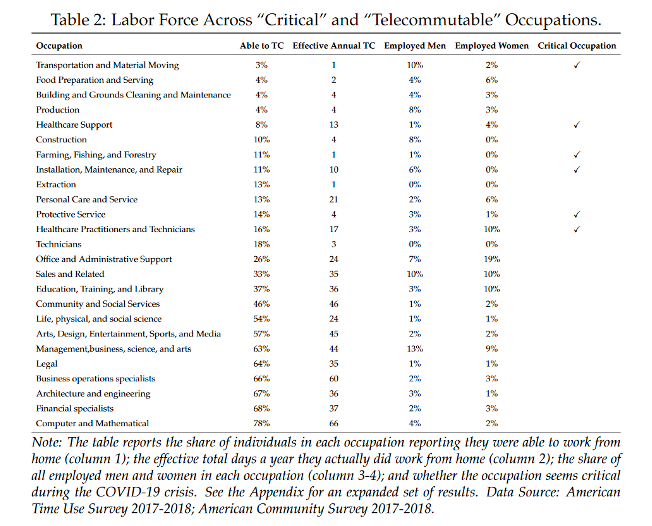
The sectors considered ‘essential’ are Transportation and Material Moving; Healthcare Support; Farming, Fishing, and Forestry; Installation, Maintenance, and Repair; Protective services; Healthcare Practitioners and Technicians. Women work in 4 out of these six sectors, and men work in 6 out of the six sectors. Moreover, 70% of women who work in healthcare services, social work, or who are frontline workers are paid less than their male counterparts.

On average, in the United States, 28% of men work in sectors that allow for telecommute compared to 22% of women. Thus, women will be more likely to face unemployment as they work in industries that cannot adapt to the new remote working format. The graph below shows which sectors are considered essential and which allow for telecommuting in the United States.

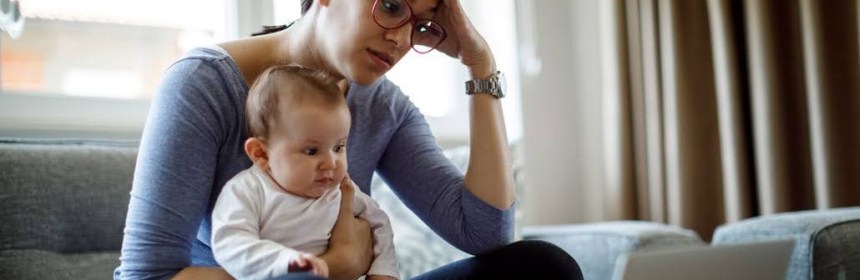
 In households where both married members can telecommute for work, the wife will most likely quit her job to provide childcare and housework. In Europe, the pandemic has exacerbated these gendered patterns, with women reducing their work hours 4 to 5 times more than men.

The closure of schools, childcare services, and day centres coupled with older relatives’ unavailability has further splintered gender inequality. There has been an increase in childcare needs with children staying at home and having classes online. The distribution of childcare needs varies on the work arrangements of the members within a household. In the United States, 25% of married couples have a traditional labour division in which men are employed full time and women stay at home. However, in only 5% of married couples, the arrangement is the opposite. In marriages with traditional work distribution, the increase in childcare needs will fall on women. The European Institute for Gender Inequality shows how, before COVID-19, married women provided 39 hours of childcare and married men provided 21 hours. The rise in childcare needs has further amplified the gendered patterns in the unequal distribution of childcare. The graph below illustrates the division of childcare and housework in households across 22 countries.

                                   Source: UN WOMEN

The division of childcare within a family reflects the existing disparities between men and women.

Single mothers are the most vulnerable to these changes. They must juggle home-schooling, the rise of childcare needs, and work. Single mothers must also rely on a single income; however, studies have shown that they are more likely to work in sectors that have been most affected by current restrictions. According to the Central Statistics Office, there are 44.5% single mother households in Ireland compared to only 18.6% single fathers. Single mother households are more at risk of living in poverty since most governments worldwide do not supply social coverage.

Nonetheless, the study The Impact of COVID-19 on Gender Inequality proposes that the flexible working format may produce greater gender equality. The conversion to remote working, adopted during the pandemic, is likely to persist in a hybrid form. More fathers will be able to participate in childcare needs and housework actively. Which can lead to an equal distribution of household tasks as both members may balance their careers with childcare needs and housework. Studies have shown that boys with a working mother will be more likely to marry a working woman contributing to changing gendered norms.

The European Institute for Gender Inequality suggests that the EU promotes education free from gendered stereotypes. Women may access less impacted sectors which allow for telecommuting. The study also states how: “Addressing women’s under-representation in STEM occupations could create up to 1.2 million jobs and increase GDP by up to EUR 820 billion by 2050.” By implementing policies that aim to reduce gender inequality in the labour market, EU member states will see higher economic growth and greater financial stability.

Cooking Up A Storm: The Importance Of Migrants and Street Food

Upon my arrival in Bavaria as part of my Erasmus programme, I was met with many nuances which were wholly expected. Namely, würst, brezel and plenty of beer from the many breweries dotting Germany’s largest Bundesland. One thing I didn’t expect were the many cultural cuisines scattered across nearly every city in Germany and the rich variety of dishes offered at great prices. Döner and Falafel have become cornerstones of youth culture within Germany and further afield too. In Dublin one is prone to find themselves enjoying a burrito or spicebag among many other dishes, which certainly do not have their routes in traditional Irish cooking. Immigrant workers have long established take outs and restaurants as a means to plant their roots in their new homeland. In appreciating the wealth of food and culture stemming from this practice, it does raise the question as to why immigrants so often turn to this practice, and how important are such businesses to a country’s economy?

A brief history lesson

Street food vending was first legalized in renaissance-era Turkey, with the selling of kebab meat being a long-established practice in the country. With Istanbul acting as a gateway between Europe and Asia, many cultures had the opportunity to try new dishes and furthermore bring tales of these tastes back home. Street food had been long been a central pillar of society within China, the Middle East and African communities. Through the emergence of mass migration across the globe by many populaces, the recipes and pallets brought along with these migrants added further depth to the cultural melting pots beginning to brew.

The backbone of the fast-food industry

Work within the catering industry has long been a source of income for migrants. With work opportunities often limited through a combination of lack of qualifications, language and sadly discrimination, many newcomers find work in the fields picking crops, cleaning dishes in a kitchen, or working as chefs also. In the United States alone, 10% of the catering industry’s workforce consists of foreign-born workers. Often this work is unappealing and lowly paid, but with few chances many migrant workers seize upon the opportunity to establish a foothold on the work ladder. This is best represented with the United States’ agricultural workforce, which consists of over 50% of undocumented immigrants.

Rising above poverty

After gaining experience within the sector, it’s easy to see why migrants would build upon their knowledge and endeavour to establish their own chains and restaurants, specializing in dishes from their homelands. These ventures present a fantastic opportunity through the combination of skills and specific culinary knowledge passed from generation to generation, along with the ability to appeal to niche markets of consumers who can’t often access such tastes within their domestic market. For many people, street food is not only a tasty treat, but also a healthy cheap source of nutrition, helping to reduce poverty in cities such as Bangkok and in turn raise ‘cultural capital’, enabling for easier mobility of people through social classes, allowing for many to escape the clutches of poverty and secure a future for their children.

Creating a springboard

All of these factors combined with the convergence effects of globalization have allowed for many of these once street vendors to establish themselves as restaurateurs and even go as far as to establish food chains. In Berlin alone there are over four thousand Döner sellers. This large density of competitors is a result of a labour agreement with the Turkish republic in 1961, allowing workers into West Germany. These numbers rose in 1974-1978, with worker’s families allowed to follow their breadwinners to the DDR (West Germany). The proximity of California to its southern neighbour, Mexico, allowed for a large influx of immigrants. The introduction of the residents of Los Angeles to foods such as Tacos as early as the 1890’s highlights how foreign food can become synonymous with a new city, with Mexican food being a core element of Los Angeles’ food culture. The introduction of the hibachi restaurant concept to New York in 1964 by Hiroaki Aoki sparked a thirst for Japanese cuisine within the United States. The restaurant grew in popularity before expanding due to increased demand. This has culminated in the Benihana franchise, with over one hundred franchised restaurants around the world.

Breaking bread with strangers

While many of these operations are still small family owned operations, operating on street corners or out of kiosks in busy train stations, they play a massive role collectively. Over 20,000 people are employed within German Döner shops, helping to support thousands of families and livelihoods. Their success also stands as a testament to the integration of the Turkish people into German culture, with the love for great street-food being a unifying factor. As globalization continues to induce effects around the world, different cuisine can often act as a bridge in allowing for a start in a new country, so too can it help to create a wider and more diverse society in the world we live in.

« Older Entries Recent Entries »