
The Economic Implications of Budget 2025
Natalie Kollrack
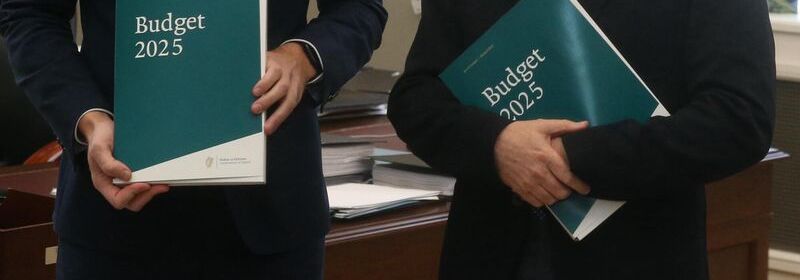
On Tuesday, 1st of October, Minister for Finance Jack Chambers and Minister for Public Expenditure, NDP Delivery and Reform Paschal Donohoe gave speeches to the Dáil Éireann announcing the Budget for 2025. The Budget was announced against a backdrop of record-level employment but unwaveringly high price levels. Advisory groups and economists alike had principal concerns regarding the budget’s size, continued breaches of spending rules and overreliance on corporation tax receipts.
Macroeconomic Policy
The Department of Finance announced that inflation has remained at or below 2% since March, which they project will improve real wages and thus increase consumer spending. The Department also projects growth in the domestic economy: modified domestic demand will increase by 2.5% in 2024 and 3% in 2025, employment will increase by almost 110,000 by the end of 2025, and unemployment will remain at 4.5%.
Fiscal Policy
The Department of Finance estimates €105.7 billion in tax revenues. They report that while surpluses are projected (€23.7 billion and €9.7 billion for 2024 and 2025, respectively), underlying deficits (€6.3 billion and €5.7 billion for 2024 and 2025, respectively) are present once subtracting ‘windfall taxes’ (revenues arising from taxation of industries with above average profits) and the one-off revenue from the Court of Justice of the European Union ruling last month, where the company Apple was required to pay €13 billion in unpaid taxes to the Irish state. About €6 billion of this ruling will be transferred to the Future Ireland Fund and the Infrastructure, Climate and Nature Fund. In addition, the Ministers announced €3 billion for infrastructure spending. Finally, Minister Donohoe celebrates his leadership in decreasing the General Government Debt, which has decreased from 110% of national income in 2020 to 69% this year, with a projected 56% in 2030.
The total budgetary package amounts to €10.5 billion, comprising a total expenditure package of €9.1 billion and a net tax package of €1.4 billion. This is further divided into an expenditure package of €6.9 billion (€5.2 billion in current spending and €1.6 billion in capital spending, rounded) and a cost of living package of €2.2 billion.
Taxation
The Department of Finance announced a personal income tax package of €1.6 billion, increasing the main tax credits and the Standard Rate Cut-Off Point and reducing the Universal Social Charge (USC). All three thresholds for Capital Acquisitions Tax (CAT), colloquially known as the inheritance tax, were also increased. In addition, measures relating to climate, support for businesses, as well as improvements in education and health were introduced and expanded. Regarding housing, Minister Chambers announced an increase in the value of the rent tax credit, an extension in the Help to Buy scheme, and an extension of the reduced VAT rate for gas and energy. In a similar suit to Budget 2024, support for landowners has continued: the Department of Finance has extended relief for pre-letting expenses for landlords, exemptions on the Residential Zoned Land Tax (RZLT), and an extension of the Mortgage Interest Tax Relief.
Package Size
Budgetary packages have been of unprecedented sizes post-pandemic: for example, this budgetary package of €9.1 billion in 2024 is an almost threefold increase from €3.6 billion in 2020. While Minister Chambers argues elevated price levels will be mitigated with the cost of living package, the Irish Fiscal Advisory Council, an independent budgetary watchdog for the Irish Government, finds the increase in prices the large budgetary packages are creating outweighs the stimulus they deliver to people, estimating a €1000 reduction in household purchasing power. In addition, the Fiscal Council finds that only half of the cost of living measures were targeted, arguing that they were not given to those most in need. Finally, the Fiscal Council draws parallels to previous financial crises to highlight the dangers of large packages at full employment. Dr Barra Roantree, Assistant Professor of Economics and Programme Director of the MSc in Economic Policy at Trinity Dublin, also draws attention to the weakened tax base created by large Celtic Tiger budgets.
Spending Rules
Since 2022, the government has exceeded its limit of increasing spending by 5% each year. The Fiscal Council estimates net spending increases of 9.2% for 2024 and 5.8% for 2025, 8.8% of the €3 billion if the additional capital spending increases are included in the figures. Minister Donohoe defends the breaches in spending as necessary for mitigating the effects of the pandemic, and Minister Chambers defends higher capital spending as needed by a higher population as well as accommodated by expenditure growth. However, the Fiscal Council, siding with the views of economists, predicts that repeated rule breaches will lead to inflation. The Central Bank also estimates prices are about 2% higher due to the rule breaches.
In addition, excessive spending and tax reliefs are especially concerning when misplaced. For example, Irish economist and writer David McWilliams argues the tax exemptions for landowners provided by the Residential Zoned Land Tax exacerbate the housing crisis by allowing landowners to hoard land. This contributes to the supply bottlenecks that harm the Irish economy: land is available for building, but bureaucratic practices prevent it from being used. McWilliams also points out the irony of a 47% increase in spending over the last five years coupled with a housing crisis, insufficient infrastructure and a widening wealth gap. In line with this finding, Dr Roantree draws on research from The Economic Social Research Institution (ESRI), which highlights the recent rise in material deprivation and rates of child income poverty, which are insufficiently mitigated by temporary payments that will be withdrawn with a new government and social welfare payments that remain, in real terms, what they were in 2020.
Finally, Ireland has the highest flat rate of inheritance tax in the EU at 33%, and the implications of raising its threshold are unclear. On one hand, Dr Roantree criticises its raising only benefiting wealthy parents’ children, a small fraction of people. Conversely, McWilliams draws attention to the growing number of cases where children are inheriting houses that they cannot afford to pay the 33% tax on without selling the property.
Corporation Tax Receipts
Minister Chambers admits the heavy reliance of public finances on corporation tax and stresses it should not be used to fund permanent expenditure measures. Thus, less than half of excess corporation tax receipts were saved. At 12.5%, Ireland has the second lowest corporation tax rate in Europe and one of the lowest in the world. Projected surpluses discussed previously are completely reliant on windfall corporation tax: the Fiscal Council estimates an €80 billion surplus, including excess corporation tax revenues (receipts above what would be explained by domestic economic activity), but a deficit of €50 billion with its exclusion during the 2024-2030 period. In addition, the corporation tax revenues have more than doubled in the last three years, suggesting further exacerbation of the underlying deficit. In addition, corporation tax is incredibly concentrated (only three companies make up 43% of all corporation tax receipts). For these reasons, the Fiscal Council is in favour of more excess corporation tax receipts being saved.
Conversely, McWilliams argues that more of the corporation tax receipts should be spent, suggesting that the revenue from the Apple ruling could be useful in mitigating the housing crisis and improving the transportation sector. He points out that Ireland, unlike most other European countries, is in a surplus and thus can afford to improve its infrastructure.
Dr Roantree agrees with the Fiscal Council. He asserts the overreliance on corporation tax receipts means Ireland needs a stable tax base, not almost €2 billion in tax cuts. He criticises the reduction of the USC, which was originally introduced to broaden, not diminish, the tax base and the multitude of reliefs given out. He argues spending should not be increased so fast when revenues could be reversed at any point in time, necessitating a rapid cutback. For example, American multinationals make up more than half of corporation tax receipts; a shift in protectionism arising from a change in government could decrease or reverse revenues. The Fiscal Council also warns against excessive reliance on corporation tax, arguing that an almost €9 billion deficit would emerge if corporation tax receipts were reversed.
Conclusion
Clearly, the Irish Government faces a balancing act. It must take advantage of excess corporation tax receipts while not further exacerbating the underlying deficit. It must take steps to address its problem of rising demand coupled with stagnant supply. Thus, its spending must be prudent to ensure it is directed to the areas that need it most.
 Trinity Business Review