
TES Startup Weekend: A Fresher’s Perspective & Success Story
Daniel O’Brien
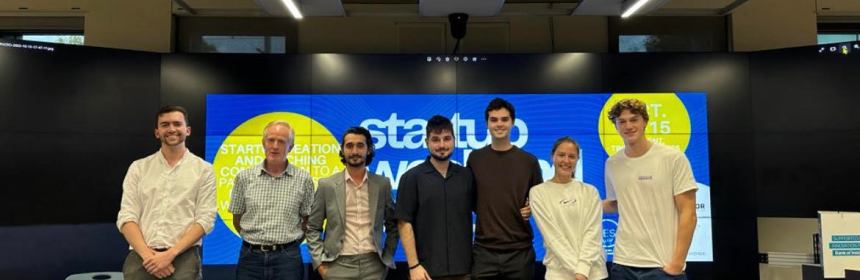
The echo of creative minds at work reverberated through Trinity Business school during the annual TES Startup Weekend last weekend, where a generous €3000 prize awaited the boldest startup pioneers. TBR correspondent, Daniel O’Brien, plunged headfirst into the event and shares his experience.
Starting with a bang
Geared toward students interested in entrepreneurship, the weekend began on Friday evening with a high-energy brainstorming session where attendees were divided into groups, each comprising a diverse mix of backgrounds and expertise. The goal of this exercise was to generate innovative business ideas that could potentially solve real-world problems. My group for this activity was nothing short of diverse, including a fourth-year Law and Business student from UCD, a 4th year Electrical Engineering student, a Postgraduate Computer Science student, a Postgraduate Entrepreneurship student, and myself. I was greatly impressed by the seriousness and quality of those in my brainstorming group; the team was active and vocal in sharing their ideas and the problems that they wanted to solve.
Day one surged ahead with great momentum, as Joseph Lanzillotta took the stage to deliver a captivating discussion on the Trinity entrepreneurship pipeline—an enlightening revelation that held my attention completely. We had a walk-through of the amazing tools Trinity has for those who want to build companies, with the key tool being the Open Incubator – a platform that allows you to plan your business ideas and organize key parts of your business. Mr. Lanzillotta is an entrepreneur himself, having founded a machine learning business related to beekeeping. The particularly enlightening part of his address delved into the transition from problem to solution. It involved reshaping the original problem into a tool that consumers could employ to tackle the issue. The timing of this talk was impeccable, considering I had arrived without a business concept or a problem to tackle. As such, Mr. Lanzillota was really able to get me thinking about what problems I had that I would like to find solutions for, and how to transform these ideas into products.
After this talk, we had the chance to walk around and meet individuals in other groups. This was particularly enticing as it allowed me to learn about the 16 ideas in the room and the entrepreneurs behind them. During this time, it became clear how diverse the number of ideas were: from physical products like drinks and makeup, to digital products like new tools for consumers and new infrastructure for businesses. This segment was beyond what I had originally conceived for the event, as it offered the opportunity to engage with an idea or group without the need for a fully structured concept. The first day concluded with us finalizing groups. In my case I decided to partner with two people from my brainstorming table, despite most people joining groups and ideas other than the ones that they had initially brainstormed with.
Day 2: Shifting to a higher gear
The second day was all about developing our pitch deck and fleshing out our ideas. These decks were needed to effectively communicate the problem, solution, target market, competitive analysis, revenue model, and the potential impact of our ideas. Personally, I found this to be the most challenging – grappling with the intricate task of distilling the crucial elements of our idea into a brief 5-minute presentation. Thankfully, we then heard from Anthony Quigley, a serial entrepreneur, speaking about his journey and advice on how to pitch our businesses. His talk featured a long Q&A session, which was a fantastic chance to discuss ideas and skills with someone who is highly acquainted with starting and running a business. Mr. Quigley has been in the process of company creation for 30 years, and I found his insights to be especially relevant to the room. Between his initial talk and the long Q&A session, Mr. Quigley’s ideas played a substantive role in helping my group make decisions on the formulation of our slides.
Also during the Saturday slide making activity were two mentors, Liam Junkermann and Charles Cullen, who walked around and discussed their experiences with each group. My group had the chance to talk with Mr. Junkerman, discussing both his experiences as a founder of Imprint Esports. This was a fascinating opportunity to glean insights from an entrepreneur’s journey that was catalyzed by the Trinity Entrepreneurial Society. He also provided valuable insights into the feasibility of my group’s idea along with practical tips on our presentation regarding what to include and how to format it.
Day 3: The grand finale
The zenith of the weekend came on the third day, with the opportunity to pitch our ideas to a panel of venture capitalists. Each group had 5 minutes to present their pitch, followed by a Q&A session that lasted about 3 minutes. After arriving on the third day, we were introduced to a panel consisting of Joe Gorman, Dick Bourke and Zaur John Unsizadeh. Gorman works at Dogpatch labs, a startup and innovation hub in the Docklands, with Dogpatch being part of a global network of 50 startup hubs supported by Google. Bourke is the founder of Scorebuddy, an internal tool used by call centers. Unsizadeh is a TCD alumni and now runs the Tangent workspace in the Trinity Business School, working with more than 100 startups on their business models.
Needless to say, the opportunity to present to such an experienced and connected panel was the cumulative highlight of this weekend, and presented a chance for participants to do something very few first year students get a chance to. As the fourth presenting team among 16, the time had come for my group. We entered the presentation room with a mix of anticipation and nerves, and embarked on our pitch. The panel was very engaged throughout the pitch and followed up with questions covering all parts of the idea – from monetisation to implementation.
Following the presentation the team awaited the results, with 12 more groups to present; this lasted several hours but was some of the most enjoyable time spent all weekend. Participants were truly remarkable, and with nothing left to do but wait, it was the perfect time to engage in conversation and further acquaint ourselves with the attendees.
After a few hours of anticipation, it was time for the winners to be announced. The room buzzed with excitement! Much to our elation, my group emerged victorious and was honoured to receive the coveted €3000 in business expense funding. As the event was wrapping up, it was apparent to me how many of the groups were going to continue with their business ideas, many of whom had no idea of a business problem before the weekend. It was clear that nearly everyone had found an idea that they wanted to pursue further.
Conclusion
For me, the real hidden value in the event was a chance to meet other like minded individuals and spend time thinking and learning alongside them. The array of highly qualified guest speakers really gave participants every chance to build new business skills, and I was especially impressed by how accessible the event was for people without pre-existing ideas, experience, or formulated groups. Overall, I highly recommend attending future TES startup weekends for anyone who has ever had an interest in any form for starting a business.
To find out more about Trinity Entrepreneurial Society, visit https://testrinity.com/.
Or, follow them on instagram here: https://www.instagram.com/testrinity/


 Trinity Business Review